


Call Centre Jobs in Cape Town, Cape Town has quietly become one of the busiest business process outsourcing (BPO) hubs on the African continent. Over the past decade, international companies from the United Kingdom, United States, and Australia have opened contact centres in the city, drawn by the strong English proficiency of local talent, favourable time zones, and lower operating costs.
This growth has translated into a steady stream of call centre jobs in cape town, spanning everything from inbound customer support to outbound sales and technical helpdesk work. For job seekers, this means more opportunities than ever before, but it also means more competition for the best positions.
That’s where jobenza.co.za comes in. As the primary hub for call centre jobs in cape town, Jobenza aggregates verified listings from BPO giants, local contact centres, and remote-friendly employers into one searchable platform. Whether you’re a first-time job seeker looking for call centre jobs in cape town with no experience or a seasoned agent hunting for a senior support role, this guide will walk you through everything you need to know: the industry landscape, the roles available, realistic salary expectations, the skills that get you hired, and exactly how to use Jobenza to land your next position.
Cape Town Call Centre Industry Overview

Why Cape Town Became a BPO Powerhouse
Cape Town’s rise as a BPO jobs Cape Town destination didn’t happen by accident. Three factors drove this growth: a large pool of English-speaking, neutral-accented talent; time zone alignment with the UK and parts of the US East Coast; and government incentives supporting the business services sector.
Industry bodies have repeatedly identified South Africa, and Cape Town specifically, as a top offshoring destination for voice and non-voice customer engagement work. This has attracted global brands in telecommunications, insurance, retail, and fintech to establish operations in the city.
Major Districts for Call Centre Employment
Job seekers should focus their search around these key nodes, as most call centre jobs in cape town cluster in a handful of business districts.
- Cape Town CBD – Home to numerous BPO head offices and financial services support centres, with strong public transport access.
- Century City – A major business park hosting several large international contact centres and tech-support operations.
- Bellville / Tyger Valley – A growing corridor for insurance, telecoms, and retail customer service teams.
- Milnerton and Montague Gardens – Increasingly popular with logistics and e-commerce support centres.
- Southern Suburbs (Claremont, Rondebosch) – Smaller boutique BPOs and outsourced support teams for niche industries.
Current Trends Shaping the Market
The sector is evolving quickly, and understanding these trends helps you position yourself as a competitive candidate.
- Hybrid and remote models are expanding. Many employers now advertise work from home jobs Cape Town for experienced agents, particularly in technical support and back-office processing.
- Omnichannel skills are in demand. Employers increasingly want agents comfortable across phone, email, live chat, and social media support simultaneously.
- Structured onboarding is standard. Most reputable employers now invest in call centre training South Africa programmes lasting one to four weeks before agents take live calls.
- Specialization pays. Technical, healthcare, and financial services support roles command higher starting salaries than general customer service positions.
Types of Call Centre Roles in Cape Town
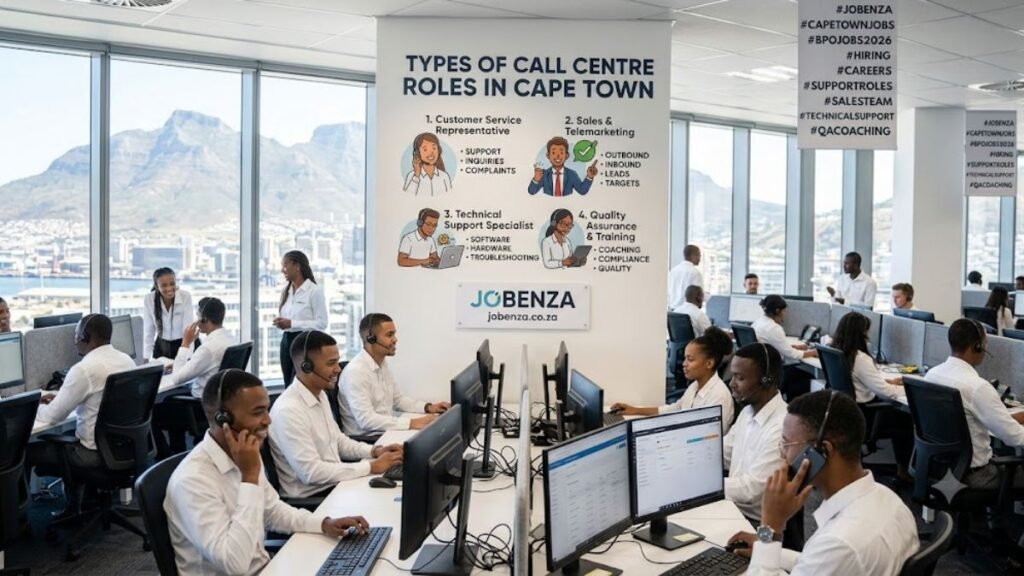
Not all call centre jobs in cape town are the same. Understanding the distinctions helps you target roles that match your strengths and long-term goals.
1. Customer Support / Service Agent
This is the most common entry point into the industry, covering general customer service vacancies across telecoms, retail, and insurance.
Core responsibilities:
- Answering inbound queries via phone, email, or live chat
- Resolving billing, account, or product issues
- Logging interactions accurately in a CRM system
Required skills: clear communication, patience, basic computer literacy, and the ability to stay calm under pressure.
2. Sales and Outbound Agent
Outbound roles focus on generating revenue through telesales, upselling, or lead generation, and typically offer commission-based earning potential.
Core responsibilities:
- Making outbound calls to prospective or existing customers
- Meeting daily or monthly sales targets
- Handling objections professionally
Required skills: persuasion, resilience, target-driven mindset, and strong product knowledge.
3. Technical Support Agent
Technical roles support software, hardware, or connectivity issues and generally require a higher skill threshold, along with better pay.
Core responsibilities:
- Diagnosing and troubleshooting technical issues
- Walking customers through step-by-step solutions
- Escalating complex cases to specialist teams
Required skills: technical aptitude, logical troubleshooting ability, and familiarity with ticketing systems.
4. Team Leader / Quality Assurance
These supervisory roles oversee agent performance and call quality, typically requiring one to three years of prior call centre experience.
Core responsibilities:
- Coaching agents and monitoring KPIs
- Conducting call audits and quality scoring
- Reporting performance metrics to management
Required skills: leadership, data analysis, conflict resolution, and coaching ability.
5. Entry-Level and No-Experience Roles
Many BPOs actively recruit for call centre jobs in cape town with no experience, provided candidates show strong communication skills and a good attitude. These roles almost always include paid, structured training before agents go live.
Salary Expectations: What You Can Realistically Earn
Salary in the call centre industry depends heavily on role type, experience level, shift requirements, and whether the employer serves local or international clients (international/offshore accounts typically pay more due to shift allowances and currency-linked incentives).
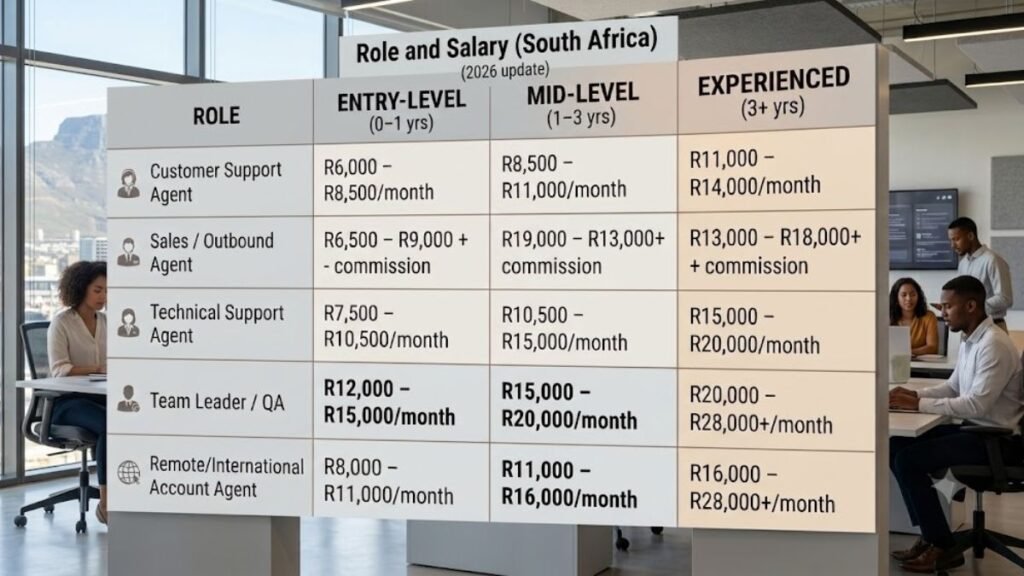
Figures are approximate monthly gross salary ranges based on typical Cape Town market rates and can vary by employer, account type, and shift allowances.
Additional earnings to factor in include night shift allowances (common for international accounts), performance bonuses, and commission structures for sales roles, all of which can meaningfully boost take-home pay beyond the base salary.
Skill Mastery: Soft Skills and Technical Tools
Standing out in a competitive job market requires more than just a friendly phone voice. Employers assess both interpersonal and technical competencies during hiring.
Essential Soft Skills
- Active listening – Understanding the customer’s real problem before responding, not just waiting for your turn to talk.
- Emotional regulation – Staying composed and professional during difficult or emotionally charged calls.
- Clear verbal communication – Speaking at a measured pace with neutral pronunciation, especially important for international accounts.
- Adaptability – Switching smoothly between different query types, channels, and customer moods throughout a shift.
- Time management – Balancing average handling time (AHT) targets with genuine customer care.
Technical Tools You Should Know
Familiarity with common software significantly improves your employability, particularly for roles requiring call centre training South Africa certification or prior CRM exposure.
- CRM systems – Salesforce, Zendesk, and Freshdesk are widely used to log and track customer interactions.
- Dialer software – Systems like Five9 or Genesys manage outbound and inbound call routing.
- Live chat platforms – Intercom and LiveChat are common for omnichannel support roles.
- Basic MS Office proficiency – Excel and Outlook remain baseline requirements across nearly all roles.
If you lack formal experience with these tools, mention any self-taught familiarity or willingness to learn quickly in your application, as most employers provide in-house training regardless.
The Jobenza Advantage: How to Find and Apply for Jobs
Jobenza.co.za is purpose-built to simplify the search for call centre jobs in cape town, cutting through the noise of generic job boards. Here’s exactly how to use the platform effectively.

Step-by-Step Guide
- Visit jobenza.co.za and navigate to the jobs search bar on the homepage.
- Enter your keyword. Search directly for “call centre jobs in cape town” or narrow it down with terms like “customer service vacancies” or “work from home jobs Cape Town.”
- Apply location filters. Select Cape Town or specific suburbs like Century City or Bellville to narrow results geographically.
- Filter by experience level. If you’re new to the industry, use the “no experience required” filter to surface call centre jobs in cape town with no experience listings.
- Filter by shift type. Choose between monday to friday call centre jobs in cape town, rotational shifts, or remote/hybrid arrangements based on your lifestyle needs.
- Review job details carefully. Check salary range, required skills, and company reputation before applying.
- Set up job alerts. Enable email notifications so new call centre jobs in cape town matching your criteria reach you immediately.
- Apply directly through the platform. Submit your CV and cover letter using Jobenza’s streamlined application process, and track your application status from your dashboard.
Using these filters strategically saves hours of scrolling through irrelevant listings and ensures you only spend time on roles genuinely suited to your experience and availability.
CV Optimization: Getting Past South African ATS Systems
Many Cape Town BPOs use Applicant Tracking Systems (ATS) to screen CVs before a human ever sees them. A poorly formatted CV can be rejected automatically, regardless of your qualifications.
ATS-Friendly Formatting Tips
- Use standard section headings like “Work Experience,” “Education,” and “Skills” rather than creative alternatives, since ATS software scans for conventional terms.
- Avoid tables, columns, and graphics in your CV file, as these often confuse ATS parsing software and can scramble your information.
- Save your CV as a Word document or simple PDF, avoiding image-based or heavily designed templates.
- Mirror the job description’s language. If the listing mentions “customer service vacancies” or “CRM experience,” include those exact phrases where genuinely applicable.
- Quantify your achievements. Instead of “handled customer calls,” write “resolved an average of 60+ customer queries per shift with a 95% satisfaction rating.”
- Keep it to two pages maximum. South African recruiters typically spend under 30 seconds on an initial CV scan.
- Include a professional summary at the top, highlighting your relevant skills and enthusiasm for call centre jobs in cape town specifically.
Common CV Mistakes to Avoid
- Listing responsibilities without measurable results
- Including irrelevant work history without context
- Using generic objectives like “seeking any position”
- Failing to list specific software or CRM tools you’ve used
Mock Interview: 5 Common Questions with STAR Method Answers
The STAR method (Situation, Task, Action, Result) helps structure clear, compelling interview answers. Here’s how to apply it to typical call centre interview questions.
1. “Tell me about a time you dealt with an angry customer.”
Situation: A customer called in furious about a billing error that had occurred twice. Task: I needed to de-escalate the situation and resolve the issue. Action: I listened without interrupting, acknowledged their frustration, and personally followed up on the billing correction. Result: The customer’s issue was resolved within 24 hours, and they thanked me directly for the follow-through.
2. “Describe a time you had to meet a difficult target.”
Situation: My team faced an unusually high call volume during a system outage. Task: I needed to maintain quality while managing my average handling time. Action: I prioritized urgent queries and used quick-reference scripts to stay efficient without sounding robotic. Result: I exceeded my daily resolution target by 15% that week.
3. “How do you handle repetitive tasks without losing motivation?”
Situation: In a previous role, I answered similar billing queries daily. Task: I wanted to stay engaged and provide consistently good service. Action: I focused on personalizing each interaction and tracking small wins in customer satisfaction scores. Result: My CSAT score remained above 90% consistently over six months.
4. “Tell me about a time you worked well in a team.”
Situation: Our team was short-staffed during a product launch with high call volumes. Task: We needed to cover extra shifts without sacrificing service quality. Action: I volunteered for additional hours and helped train two newer agents on common queries. Result: We maintained our service level agreement (SLA) throughout the launch period.
5. “Why do you want to work in a call centre environment?”
Situation: I’ve always enjoyed problem-solving and helping people directly. Task: I wanted a role where communication skills are central to daily work. Action: I researched the BPO industry in Cape Town and its growth, applying specifically for call centre jobs in cape town that align with my skills. Result: I’m confident this role lets me combine my strengths with a clear path for career growth.
Future Outlook: Career Progression in the Call Centre Industry
A career in Cape Town’s call centre sector isn’t a dead end; it’s often a launchpad. Many senior BPO managers, HR professionals, and even operations directors started their careers as frontline agents.
Typical Career Path
- Customer Service / Sales Agent (0–2 years)
- Senior Agent / Subject Matter Expert (1–3 years)
- Team Leader / Quality Analyst (2–4 years)
- Operations Manager / Training Manager (4–7 years)
- Site Manager / Regional Operations Director (7+ years)
Lateral moves are also common, with experienced agents transitioning into recruitment, HR, workforce planning, or corporate training roles, particularly those involved in call centre training South Africa initiatives.
As more employers adopt flexible working models, agents who prove reliable in-office often earn the opportunity to move into work from home jobs Cape Town arrangements, a strong incentive worth negotiating for once you’ve built a solid track record.
Conclusion
Cape Town’s call centre and BPO sector offers something increasingly rare in today’s job market: genuine accessibility for entry-level candidates combined with real, structured paths to long-term career growth. Whether you’re searching for your very first job, a monday to friday call centre jobs in cape town with predictable hours, or a flexible work from home jobs Cape Town opportunity, the opportunities are real and growing.
The key is knowing where to look, how to present yourself, and how to prepare for the hiring process. With the salary benchmarks, skill priorities, and interview strategies covered in this guide, you’re now equipped to approach your job search with confidence.
Ready to take the next step? Browse the latest call centre jobs in cape town on jobenza.co.za today, set up your personalized job alerts, and start applying to verified customer service vacancies that match your experience and goals.