


The demand for reliable, loving childcare has never been higher in the Mother City. From the sea-facing apartments of the Atlantic Seaboard to the leafy family homes of the Southern Suburbs and the fast-growing estates of the Northern Suburbs, parents across Cape Town are searching for one thing: a nanny they can genuinely trust. If you’re exploring nanny jobs in Cape Town, you’re entering a market that is both competitive and full of genuine opportunity, provided you know how to position yourself correctly. This guide breaks down everything a job seeker needs, from qualifications and salaries to safety checks and a step-by-step plan for landing your next role.
Cape Town’s childcare sector has changed dramatically over the past few years. Dual-income households, the rise of semigration into the Western Cape, and a growing preference for personalised, home-based care over large daycare centres have all combined to create sustained demand for skilled nannies, au pairs, and domestic childcare workers. Whether you’re an experienced caregiver looking for your next placement or someone entering the industry for the first time, understanding this landscape is the first step toward building a stable, well-paying career.
The Current Landscape of Childcare Jobs in Cape Town

Cape Town’s childcare economy has grown steadily as more households prioritise structured, in-home care over institutional alternatives. This shift has been driven by flexible work arrangements, a preference for smaller caregiver-to-child ratios, and a renewed focus on early childhood development (ECD) outcomes.
Types of Employment Available
Understanding the different employment structures will help you target the right roles for your lifestyle and financial goals.
- Full-time live-out nanny: The most common arrangement, typically Monday to Friday, with the nanny commuting from her own residence.
- Live-in nanny vacancies Cape Town: These positions are especially popular among families in areas like Constantia, Bishopscourt, and the Southern Suburbs, where accommodation is offered as part of the package. Live-in roles suit candidates relocating from other provinces or those seeking reduced commuting costs.
- Part-time or after-school care: Ideal for candidates studying further or balancing multiple income streams, often covering school pick-ups, homework supervision, and evening routines.
- Au pair positions: Common among younger candidates, often combined with light educational duties, tutoring, or driving responsibilities.
- Domestic worker jobs Western Cape with childcare duties: Many households combine general housekeeping with childcare, particularly in smaller family units where a dedicated nanny isn’t required full-time.
- Newborn or maternity nurse roles: Specialised, short-term contracts requiring night-duty experience and infant care training.
Where the Demand Is Concentrated
The Atlantic Seaboard (Camps Bay, Sea Point, Green Point) tends to favour English-speaking, well-presented candidates for high-net-worth households, often requiring flexibility around travel schedules. The City Bowl and surrounds favour candidates comfortable with apartment living and urban routines. The Northern Suburbs (Durbanville, Bellville, Table View) and Southern Suburbs (Constantia, Claremont, Rondebosch, Newlands) offer more traditional, family-home-based positions, frequently with long-term stability and strong word-of-mouth referral networks.
“Families are no longer just looking for babysitters. They want partners in their children’s development — someone who understands routine, safety, and early learning.” This shift is precisely why qualifications now matter more than ever in this industry.
Requirements & Qualifications Employers Actually Look For
Gone are the days when a friendly personality alone would secure a placement. Today’s Cape Town parents are informed, cautious, and increasingly demand documented proof of competence and trustworthiness.
Essential Documentation
- South African ID or valid work permit — Employers are legally required to confirm your right to work in South Africa. Foreign nationals must present a valid visa permitting employment.
- Police clearance for nannies — This is now considered non-negotiable by the majority of reputable families and agencies. A clean police clearance certificate, obtainable through the South African Police Service (SAPS), reassures parents that you have no history of criminal behaviour, particularly relating to violence or dishonesty.
- Contactable references — At least two to three previous employers who can verify your work history, character, and reliability. Written reference letters carry significant weight, especially when accompanied by a phone number.
- First Aid Level 1 or 2 certification — Increasingly treated as a baseline requirement rather than a bonus. Courses are widely available through accredited training providers across Cape Town and typically take one to two days to complete.
- ECD (Early Childhood Development) certificate or NQF-aligned qualification — While not always mandatory, candidates with formal ECD training command significantly higher salaries and are prioritised for infant and toddler-specific roles.
Soft Skills That Set Candidates Apart
- Strong communication skills, particularly the ability to update parents clearly and proactively.
- Patience and emotional regulation, especially when managing tantrums or sibling conflict.
- Basic nutritional knowledge for meal preparation.
- Confidence with school-run logistics, homework routines, and extracurricular scheduling.
- Swimming ability, given the prevalence of home pools across Cape Town’s suburbs.
- A valid driver’s licence, which dramatically increases employability for school-run and activity-transport duties.
Additional Checks Families May Request
Many households now conduct their own supplementary vetting beyond documentation, including trial days, home visits, and informal reference calls to mutual contacts. Being transparent and proactive about offering this information upfront signals professionalism and builds immediate trust.
Average Salary Breakdown: What Nannies Really Earn in Cape Town
One of the most searched questions among job seekers relates to childcare provider salary South Africa benchmarks. While rates vary based on suburb, experience, and job scope, here is a realistic breakdown based on current market conditions.
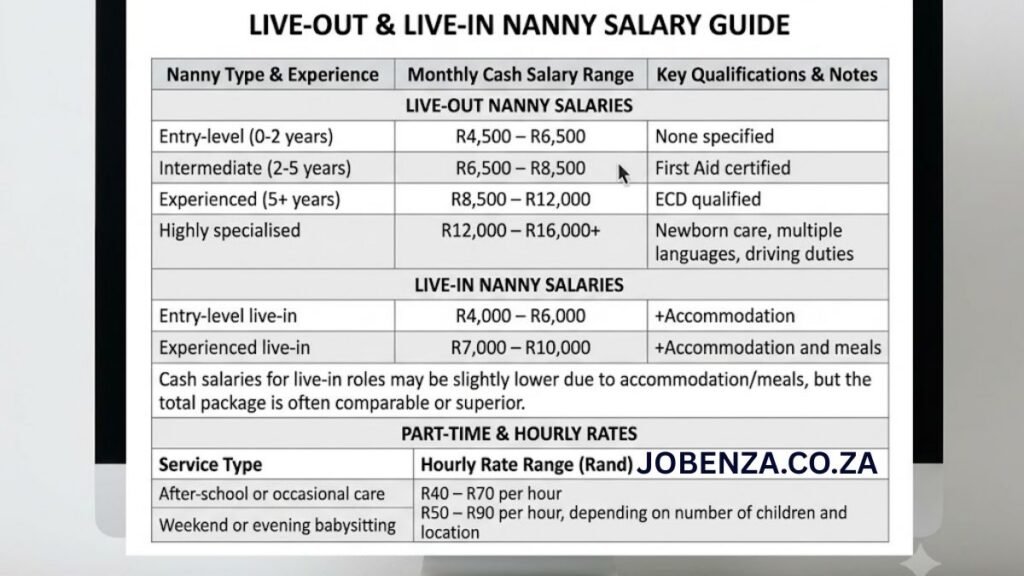
Factors That Influence Pay
Suburb affluence plays a significant role, with Atlantic Seaboard and Constantia-based families generally offering premiums above the citywide average. Additional responsibilities such as pet care, light housekeeping, tutoring, or overnight shifts should always be reflected in negotiated pay. Employers are legally required to register domestic workers, including nannies, with the Unemployment Insurance Fund (UIF) and adhere to the Basic Conditions of Employment Act, which governs minimum wage, leave entitlements, and working hours.
Always request a written employment contract outlining salary, working hours, leave days, and notice periods. Verbal agreements offer no legal protection for either party.
Step-by-Step Guide for Job Seekers
Securing quality nanny jobs in Cape Town requires more than luck. Follow this structured approach to maximise your chances.
Step 1: Build a Winning CV
Your CV should immediately communicate trustworthiness and competence.
- Lead with your total years of childcare experience and any specialised training.
- List age ranges you’ve cared for (infants, toddlers, school-going children).
- Include certifications with dates, such as First Aid or ECD qualifications.
- Provide two to three references with names, relationship, and contact numbers.
- Keep formatting clean, avoid excessive jargon, and limit your CV to one or two pages.
Step 2: Create a Professional Online Presence
Many families now search for candidates on job platforms before advertising publicly. Ensure your profile photo is professional and current, your bio highlights your childcare philosophy, and your contact details are accurate and monitored regularly.
Step 3: Prepare for the Interview
- Research the family’s needs beforehand if any details were shared in the listing.
- Prepare specific examples demonstrating patience, problem-solving, and initiative.
- Ask thoughtful questions about routines, disciplinary approach, and household expectations.
- Dress neatly and arrive on time, treating the interview with the same seriousness as any corporate role.
Step 4: Navigate the Trial Period
Most reputable families request a paid trial day or week before finalising an offer. Use this time to demonstrate initiative, ask clarifying questions, and show genuine warmth toward the children.
Step 5: Negotiate Fairly
Enter negotiations armed with realistic salary benchmarks from the breakdown above. Be transparent about your minimum acceptable rate while remaining flexible on non-salary benefits like meals, transport allowances, or reduced hours.
Step 6: Formalise the Agreement
Insist on a written contract before your first official day. This protects both you and the employing family and should outline salary, hours, leave, notice period, and specific duties.
Safety & Verification: How to Find Trusted Nanny Work

Unfortunately, the demand for childcare has also attracted opportunistic scammers targeting vulnerable job seekers. Protecting yourself is essential.
Red Flags to Watch For
- Employers who refuse any form of video or in-person interview before hiring.
- Requests for upfront payment for “training materials,” “registration,” or “background check processing.”
- Vague job descriptions with unusually high salaries for minimal experience required.
- Communication exclusively through unofficial messaging apps with no verifiable business or household presence.
- Pressure to accept a position immediately without time to consider or verify details.
How to Find Trusted Nanny Work Safely
- Use reputable, established job platforms rather than informal social media groups with limited moderation.
- Verify the employer’s identity where possible, including confirming the physical address of the household.
- Never share banking PINs, ID copies, or sensitive documents before an official offer and contract are in place.
- Meet in safe, neutral, or verifiable locations for initial interviews if a home visit isn’t immediately offered.
- Trust your instincts — if something feels inconsistent or rushed, slow the process down or walk away entirely.
- Register with recognised domestic and childcare agencies in Cape Town, which typically conduct their own vetting on both employers and employees, adding a layer of protection.
A trustworthy employer will never rush you, will welcome your questions, and will happily provide references from previous or current staff.
Find Your Next Opportunity on jobenza.co.za
Searching for the right nanny position shouldn’t feel overwhelming or uncertain. This is exactly where jobenza.co.za becomes an invaluable resource for childcare job seekers across Cape Town and the wider Western Cape.
Jobenza.co.za has established itself as a premier destination for South African job seekers looking for verified, daily-updated listings across every sector, including domestic and childcare work. Rather than sifting through unmoderated classifieds or risking contact with unverified individuals, job seekers can browse listings that are refreshed regularly, giving you first access to new opportunities in Cape Town’s most sought-after suburbs.
Here’s why job seekers are choosing jobenza.co.za as their go-to platform:
- Daily updated listings mean you’re never browsing stale, already-filled positions.
- A streamlined resume upload feature allows you to create a strong, visible profile that employers can discover directly.
- Connections with verified employers reduce the risk of scams and time-wasting, unreliable job posts.
- A user-friendly interface designed for job seekers at every experience level, from first-time nannies to seasoned childcare professionals.
- Broader career opportunities beyond childcare, useful for candidates open to related domestic or hospitality roles as their circumstances evolve.
Take a moment to upload your resume today, complete your profile with your certifications and references, and set aside time each week to browse new postings. Bookmark jobenza.co.za as part of your regular job search routine, and position yourself to be first in line when the right family posts their next opening.
Final Thoughts
Cape Town’s childcare industry offers genuine, sustainable career opportunities for dedicated, well-prepared candidates. Success in this competitive market comes down to three fundamentals: proper documentation and certification, honest and confident self-presentation, and vigilance around safety and verification throughout your job search. By following the structured approach outlined in this guide, from building a standout CV to negotiating fair pay and protecting yourself from scams, you’ll be well positioned to secure a rewarding, stable role with a family that values and respects your work.
The opportunities are there. With the right preparation, a trustworthy platform like jobenza.co.za by your side, and a clear understanding of your worth in this market, your next great nanny position in Cape Town could be closer than you think.