


Searching for uj jobs in south africa puts you in competition with thousands of graduates and professionals every month. The University of Johannesburg is one of the largest contact universities in the country, teaching over 50 000 students across four campuses. An institution that size needs lecturers, laboratory technicians, finance officers, librarians, cleaners, IT specialists and project managers — and it advertises those roles continuously.
The problem is not a shortage of posts. It is that most applicants never get past online screening. They upload the wrong documents, miss the closing date by hours, or submit a generic CV that ignores the advertised requirements.
This guide fixes that. You will learn how University of Johannesburg vacancies are structured, which categories of employment exist, how the UJ career portal works, what qualification standards apply in higher education employment South Africa, and how to prepare for the interview panel.
We also cover where to track latest South African job vacancies daily so you never miss a closing date again. Whether you are chasing academic jobs in Johannesburg or your first administrative post, treat this as your working checklist.
Understanding the Landscape of University of Johannesburg Vacancies

UJ was formed in 2005 through the merger of Rand Afrikaans University, Technikon Witwatersrand, and the Soweto and East Rand campuses of Vista University. That history matters to you as a job seeker.
The merger left UJ with a mixed identity: traditional research faculties alongside strong vocational and professional programmes. The vacancy list swings between doctoral-level research chairs and hands-on technician posts in the same week.
The Four Campuses and What They Hire For
Every advert on the UJ career portal specifies a campus, so knowing which campus does what helps you target realistically across Gauteng.
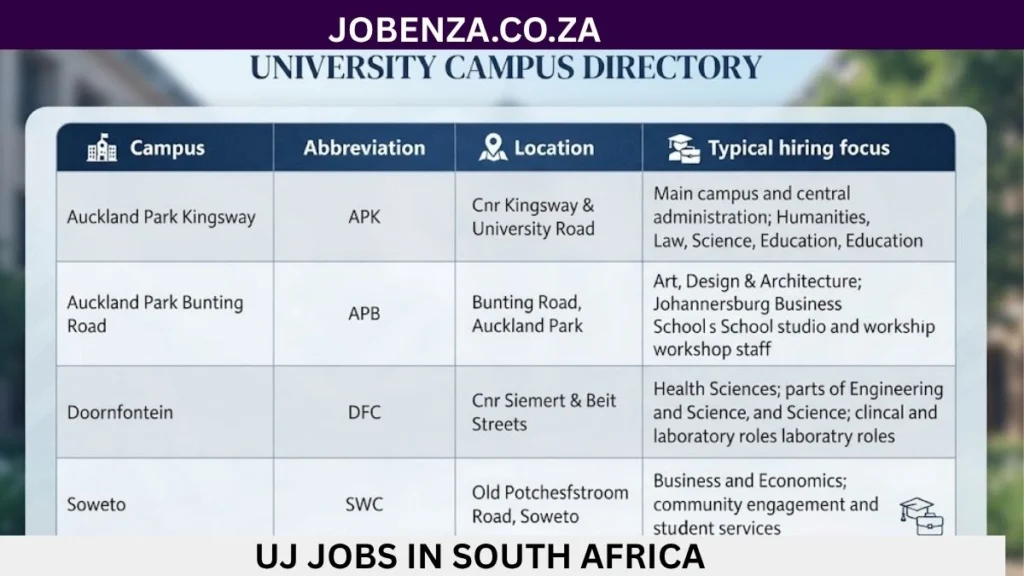
A free inter-campus shuttle runs between all four sites. Mention your willingness to work across campuses in your cover letter — many support and technical posts are multi-site.
The Faculty Structure Behind Most Adverts
Academic posts are advertised at department level, inside a faculty. UJ’s academic structure includes:
- Faculty of Humanities
- Faculty of Science
- Faculty of Education
- Faculty of Law
- Faculty of Health Sciences
- Faculty of Art, Design and Architecture (FADA)
- Faculty of Engineering and the Built Environment (FEBE)
- College of Business and Economics (CBE), which houses the Johannesburg Business School
The College of Business and Economics is the largest unit by student numbers. Formed in 2017, it consistently generates the highest volume of academic jobs in Johannesburg at UJ.
Why UJ Recruits All Year Round
Universities do not hire in one annual batch. Four cycles run at once:
- Permanent academic posts — as departments grow, retire staff or win new programme accreditation.
- Fixed-term contract lecturing — heaviest in November to January, and again in May to June.
- Professional and support services — advertised continuously as resignations occur.
- Research posts tied to grants — whenever a research chair or external partnership is funded.
The practical lesson: checking the portal once a month is useless. High-demand posts often close two weeks after posting.
Categories of Employment Available at UJ
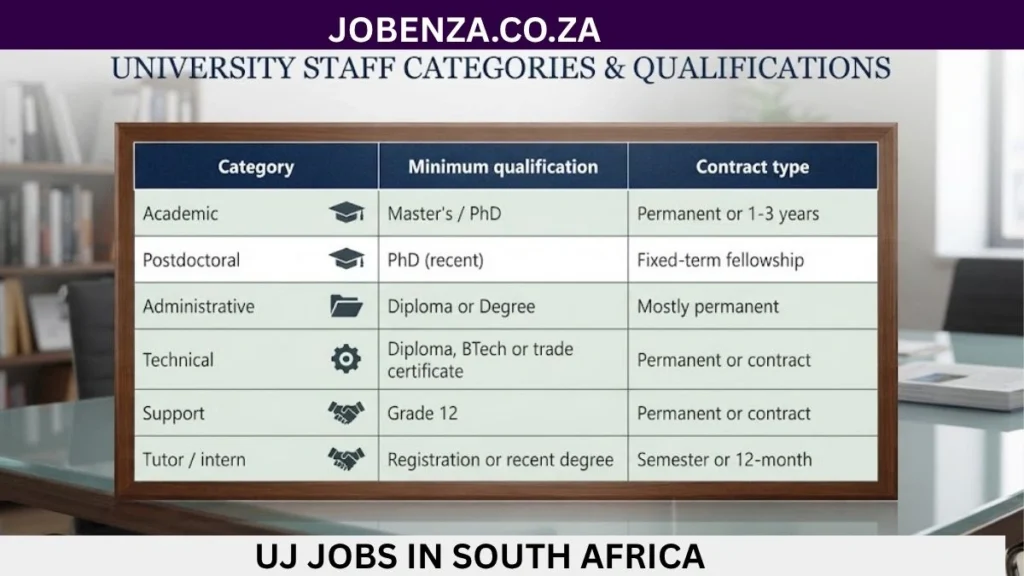
Understanding which category you fall into changes how you write your CV. UJ evaluates each category against completely different criteria.
1. Academic Posts
The teaching and research track follows a clear ladder:
- Junior Lecturer — Master’s degree in progress or completed; heavy tutorial and marking load.
- Lecturer — Master’s degree minimum, doctorate strongly preferred; teaching, assessment and emerging research output.
- Senior Lecturer — PhD required, plus peer-reviewed publications and postgraduate supervision.
- Associate Professor — established national research profile, successful PhD supervision, external examination.
- Professor — international standing, sustained publication record, research leadership and funding attraction.
Academic adverts list research output, postgraduate supervision and community engagement as scored criteria. If your CV only describes teaching, you are scoring on one dimension of four.
2. Research Positions
Separate from teaching posts, these include postdoctoral research fellows, research assistants and staff attached to research centres and SARChI chairs.
Postdoctoral fellowships are typically fixed-term (one to three years) and require a PhD completed within the last five years. They are the most realistic entry point for early-career researchers.
3. Administrative and Professional Services
The largest category by headcount, and the one most job seekers overlook. Roles include:
- Faculty officers, academic administrators and student enquiry staff
- Human resources practitioners, payroll and recruitment officers
- Finance clerks, management accountants, procurement and supply-chain officers
- Marketing, communications, digital content and events coordinators
- Librarians, cataloguers and information specialists
- Student housing, sport, counselling and academic development staff
Entry requirements typically start at a National Diploma or Bachelor’s degree plus two to five years of relevant experience.
4. Technical and Laboratory Roles
UJ’s engineering, science, health and design faculties run heavy infrastructure, creating demand for laboratory technicians and technologists, workshop technicians in FADA and FEBE studios, instrumentation, electrical and mechanical artisans, and ICT and network support staff.
Most require a National Diploma, BTech or Advanced Diploma, and trade-tested artisans need a valid red seal where applicable.
5. Support and Operational Staff
These roles keep the campuses running: protection services officers, groundskeepers, cleaning staff, catering assistants, drivers and maintenance handymen.
Entry requirements are usually Grade 12 (Matric) with relevant experience. Security posts require valid PSIRA registration at the appropriate grade.
6. Student Assistants, Tutors and Internships
Registered UJ students and recent graduates can access peer tutoring, marking assistant, library assistant and graduate internship opportunities. These are usually advertised through faculties, departments and UJ Career Services rather than the main recruitment portal.
How to Apply for UJ Jobs: A Step-by-Step Guide
Knowing how to apply for UJ jobs correctly is genuinely half the battle. UJ uses a centralised online recruitment system, and applications submitted by email to a department are almost always discarded.
Step 1: Go to the Official Recruitment Portal
Start at uj.ac.za and navigate to the UJ Jobs or Human Resources → Vacancies page. From there you are directed to the employee recruitment portal at jobs.uj.ac.za, which hosts every formally advertised post.
Bookmark it directly. Never apply through a third-party site that asks for payment — UJ never charges an application fee.
Step 2: Register a Profile
Create an account using a professional email address you check daily. Choose a strong password (the system requires at least one special character) and record your security answers somewhere safe.
Step 3: Build Your Full Digital Profile
The system asks for personal details, ID number, education history, employment history, professional registrations and references.
An incomplete profile is the single most common reason for automatic rejection. Complete every field, because screening committees read the exported profile, not just your attached CV.
Step 4: Prepare Documents Before You Search
Save these as PDFs with clear file names such as Surname_CV_2026.pdf:
- Detailed CV (academic CV for teaching and research posts)
- Certified copy of your South African ID or passport and work permit
- Certified copies of all qualifications and transcripts
- SAQA evaluation certificate for foreign qualifications
- Proof of professional registration (HPCSA, SACE, ECSA, SAICA, PSIRA)
- Contact details for three contactable referees
Pro tip: upload limits defeat many applicants. Where the system allows one supporting-documents attachment, merge your certificates into a single PDF.
Step 5: Search and Filter Vacancies Strategically
Filter by faculty, campus and closing date. Read the full advert, not just the title — the reference number, contract type and enquiries contact are in the body. Record the reference number for every post; you will need it for follow-up.
Step 6: Tailor Your CV and Cover Letter to the Advert
This is where most people lose. Take the advert’s “Minimum Requirements” and “Key Performance Areas” and mirror that language in your CV, with evidence behind each claim. Panels literally score every requirement as met or not met.
Keep the cover letter to one page, addressed to the specific post and reference number.
Step 7: Submit Well Before the Closing Date
Portals slow down on the final day as everyone submits at once. Aim to submit at least 48 hours early, then confirm the status shows as received and save the confirmation email.
Step 8: Follow Up Professionally
Adverts usually state that applicants not contacted within a set period — often two to eight weeks after closing — should consider themselves unsuccessful. One polite enquiry quoting the reference number is fine. Repeated calls are not.
Mistakes That Get Applications Discarded
- Uncertified or expired certified copies
- Missing SAQA evaluation for a foreign degree
- Applying without meeting the stated minimum requirement
- A generic CV with no reference to the advert
- Referees you never asked for permission
- Unexplained employment gaps
Essential Requirements and Qualification Standards in South African Higher Education
Higher education employment South Africa is a regulated space. Understanding the framework tells you exactly which posts you qualify for today and what you need for the next rung.
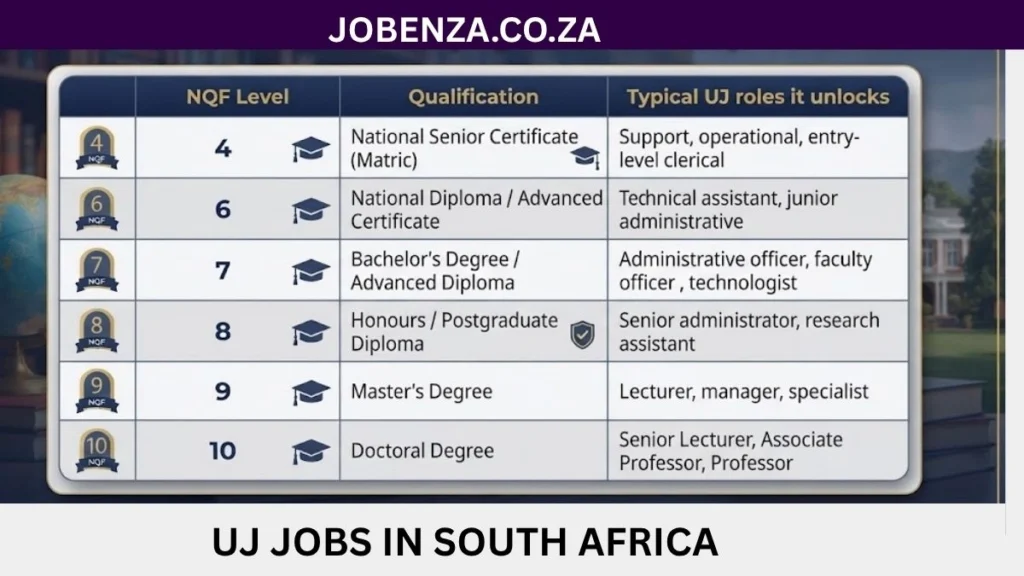
The NQF Framework in Practice
South African qualifications sit on the National Qualifications Framework (NQF), and university adverts routinely quote NQF levels rather than qualification names.
Foreign Qualifications and SAQA
If you studied outside South Africa, your qualification must be evaluated by the South African Qualifications Authority (SAQA). Apply early — evaluation can take several months, and no university will appoint you without it.
Non-citizens also need a valid work visa or critical skills visa. UJ advertises internationally for scarce academic skills, but the visa burden sits with the applicant.
Professional Registration Where It Applies
Depending on the role, you may need current registration with bodies such as:
- HPCSA or SANC for health sciences and clinical teaching
- SACE for education faculty staff who teach practising teachers
- ECSA for engineering academic and technical posts
- SAICA / SAIPA / CIMA for accounting and finance roles
- PSIRA for protection services
Employment Equity and Transformation
Like all South African public universities, UJ appoints in line with the Employment Equity Act and its own equity plan, and adverts frequently state that preference will be given to candidates from designated groups. This does not exclude other applicants — the departmental equity profile is one factor alongside qualification, experience and interview performance.
The Soft Requirements Nobody Advertises
Beyond paper qualifications, screening panels reward digital fluency with learning management systems, demonstrated student-centredness, multilingual ability, and visible commitment to continuous professional development.
Streamlining Your Search With jobenza.co.za
The uncomfortable truth about university recruitment is that the portal only shows what is live right now. If a post closed yesterday, you will never know it existed.
That is the gap jobenza.co.za closes. It is a South African recruitment portal that aggregates and verifies active vacancies nationwide, so you spend your time applying rather than hunting — one filtered feed instead of a dozen institutional portals.
What You Get on jobenza.co.za
- Daily verified listings — new vacancies published as they go live, including university, government and private sector roles
- Filter by province, city and sector — narrow straight to Gauteng, Johannesburg or the education sector
- Filter by qualification level — see only the Matric, Diploma, Degree or Postgraduate roles you actually qualify for
- Closing dates displayed clearly — no more discovering a post the day after it shut
- Direct application routing — you are sent to the official employer portal, never to a paywall
- CV and cover letter guidance — practical templates and advice tuned to South African hiring norms
- Interview preparation resources — sector-specific question banks and preparation checklists
How to Use It Alongside the UJ Portal
Treat the two as a pair, not as alternatives:
- Set saved searches on jobenza.co.za for “Johannesburg”, “education” and your qualification level.
- Check the feed every morning — five minutes is enough.
- When a UJ post appears, click through and apply on the official UJ career portal.
- Use the Jobenza CV and interview resources before you submit.
The advantage is speed. Applications submitted in the first 72 hours are read by fresher, less fatigued screening panels.
Bookmark jobenza.co.za and make it the first tab you open. Consistency beats intensity — ten focused minutes daily outperforms a frantic Sunday every time.
Insider Tips to Ace a UJ Interview and Secure Your Position
An invitation means you have already cleared the qualification hurdle. Now the panel is testing fit, judgement and preparation.
Expect a Panel, Not a Chat
University interviews are almost always panel interviews. For an academic post, expect the Head of Department, a faculty representative, an HR practitioner and sometimes an external subject expert.
Each panellist scores you against a fixed rubric, so answer to the whole room, not only to the person who asked.
Prepare for the Teaching Demonstration
For lecturing posts, you will often deliver a 10 to 20 minute teaching demonstration or research presentation.
- Confirm the topic, audience level and time limit in advance
- Finish early rather than late
- Show your teaching philosophy in action — engagement, not just slides
- Bring a printed handout; technology fails
Use the STAR Method for Competency Questions
Structure every behavioural answer as Situation, Task, Action, Result, and always land on a measurable result.
Weak answer: “I improved the registration process.” Strong answer: “I redesigned the intake checklist, which cut average student query resolution from five days to two over one semester.”
Know the Institution Genuinely
Panels can tell within ninety seconds whether you have read anything about UJ. Be able to speak to its four campuses and where your post sits, the department’s research focus and two or three recent publications, UJ’s strategic emphasis on technology and innovation, and its position as one of South Africa’s largest contact universities.
Anticipate the Standard Questions
- Why UJ specifically, rather than any other university?
- How would you support students who arrive underprepared?
- Describe your research trajectory for the next five years.
- How do you handle conflict with a colleague or a difficult student?
- What would you achieve in your first 90 days in this role?
Bring Your Paperwork and Ask Smart Questions
Carry originals and certified copies of everything, plus extra printed CVs.
When invited to ask questions, avoid salary as your opener. Ask about teaching load allocation, research support and funding, or how the department measures success in the role.
Within 24 hours, send a short thank-you email to the panel chair referencing one specific point from the conversation. It costs nothing and keeps you memorable.
Frequently Asked Questions About UJ Jobs
How do I find current University of Johannesburg vacancies?
All formally advertised posts appear on UJ’s official employee recruitment portal, reachable from the UJ Jobs page on uj.ac.za. For daily aggregated alerts across UJ and other employers, track listings on jobenza.co.za.
Does UJ charge a fee to apply for a job?
No. UJ does not charge any application fee. Any person or website demanding payment for a UJ application, interview or “guaranteed placement” is running a scam. Never pay, and never share your banking details.
What qualifications do I need to become a lecturer at UJ?
A Master’s degree in the relevant discipline is the usual minimum, with a doctorate strongly preferred and required for Senior Lecturer and above. Teaching experience, publications and postgraduate supervision strengthen your application significantly.
Can foreign nationals apply for UJ jobs in South Africa?
Yes. Foreign nationals may apply, particularly for scarce-skill academic and research posts. You will need a SAQA evaluation of your qualifications and a valid work or critical skills visa before appointment can be finalised.
How long does the UJ recruitment process take?
It varies. Support and administrative appointments often conclude within four to eight weeks of the closing date, while academic and senior posts can take three months or longer because of faculty committee and council approval stages.
Are there entry-level jobs at UJ for matriculants?
Yes. Grade 12 is the standard entry requirement for many operational and support roles, including protection services, cleaning, catering, grounds maintenance and some clerical positions. Internships and student assistant posts are advertised through faculties and UJ Career Services.
What should I do if I never hear back after applying?
Most adverts state that if you have not been contacted within a specified window after the closing date, the application was unsuccessful. Competitive posts attract hundreds of applicants. Request feedback where offered, refine your CV, and apply again.
Conclusion: Turn Your Search Into a System
Landing one of the many uj jobs in south africa is not about luck. It is about three disciplines applied consistently.
Know the terrain. Understand which campus and faculty you are targeting, and which employment category your qualifications genuinely fit.
Apply properly. Complete your portal profile, prepare certified documents in advance, mirror the advert’s language, and submit early.
Prepare for the room. Rehearse your demonstration, structure answers with STAR, and walk in knowing something real about the department.
The final ingredient is speed. Vacancies open and close continuously, and the strongest applications are usually the earliest ones.
Visit jobenza.co.za now, set your filters for Johannesburg and the education sector, and check the feed every morning. Verified listings, clear closing dates, direct routing to official employer portals — in one place.
Your next role is already being advertised somewhere. Make sure you are the applicant who sees it first.