


South Africa has quietly become one of the world’s most reliable talent pools for virtual education. Every evening, thousands of tutors in Cape Town, Pretoria, Polokwane and Gqeberha log in to teach students in Seoul, São Paulo, Riyadh and Shanghai. If you have strong English, a stable connection and a few free hours, online english teaching jobs in south africa are one of the fastest routes to earning foreign currency without leaving your home.
The shift is not a fad. Global demand for English tuition keeps climbing, while employers have realised that South African teachers offer a rare combination: clear, neutral English, strong work ethic, and a time zone that overlaps beautifully with both Asia and Europe.
Add the weak rand, and even a modest dollar rate stretches surprisingly far at home.
This guide is built for people who want more than a list of websites. You will learn exactly what qualifications matter, which platforms genuinely accept South Africans, what the realistic pay bands look like in 2026, how to build a profile that gets booked, and how to grow from a side hustle into a full income.
Whether you are a retrenched professional, a stay-at-home parent, a matric graduate or a qualified SACE teacher wanting extra income, there is a seat for you in the virtual classroom.
Let’s get you into it.
Section 1: The Rise of Virtual Classrooms — Why South Africans Are Thriving in Remote ESL Careers
The online education market did not shrink after the pandemic. It matured. Students who once tried Zoom lessons out of necessity now prefer them, and language learning is the single biggest category in that shift.
That has created steady, year-round demand for conversational and exam-focused English tutors.
South Africans sit in an unusually strong position in this market. Here is why employers keep coming back to us.
- Accent advantage: The standard South African English accent is widely described as clear and easy to follow, with crisp vowels and steady pacing. Learners in Asia and the Middle East consistently rate it as easy to understand.
- Time zone gold: SAST is perfectly placed. You can teach European learners in the afternoon, Middle Eastern learners in the early evening, and Asian learners in the early morning without destroying your sleep.
- Cost arbitrage: A rate that looks average in dollars becomes meaningful income in rand. R200 an hour for evening work beats most local part-time options.
- English fluency at scale: English is the country’s dominant language of business, higher education and media, giving millions of South Africans professional-level command of it.
- Digital readiness: Fibre coverage in metros has expanded dramatically, and mobile data competition has pushed prices down.
The result is a genuine wave of flexi-time digital teaching careers across the country.
You will find work from home teaching jobs in Durban being done from Umhlanga apartments and work from home teaching jobs in Johannesburg run out of converted spare rooms in Randburg. Geography stopped mattering the day fibre arrived.
There is a second, less-discussed benefit: skills transfer. Online teaching builds client communication, digital fluency, scheduling discipline and self-marketing.
Those skills open doors into curriculum design, customer success, e-learning production and corporate training later on.
Section 2: Essential Qualifications, Equipment and Setup
Let’s clear up the biggest myth first. You do not need a university degree to start, and you do not need to be from the UK or the USA.
You do need to be credible, prepared and technically reliable.
2.1 TEFL and TESOL Certification
A 120-hour accredited TEFL certificate is the industry standard entry ticket. Most reputable platforms either require it or pay certified tutors more.
Getting tefl certification south africa sorted should be your first investment. Focus on these points when choosing a course:
- Minimum 120 hours. Anything shorter is treated as a taster course, not a qualification.
- Recognised accreditation. Look for external, verifiable accreditation rather than self-issued badges.
- Practical teaching component. Courses with observed teaching practice or video assessment carry far more weight in interviews.
- Specialist add-ons. Modules in Teaching Young Learners, Business English or IELTS preparation directly raise your earning ceiling.
- Realistic pricing. Quality online courses generally sit in the R1,500 to R6,000 band, and sales are frequent.
TESOL and TEFL are used almost interchangeably by employers. Do not overthink the acronym; focus on hours and accreditation.
2.2 The Degree Question
Here is the honest answer on how to teach english online without a degree: it is completely possible, but it narrows your options.
Degree-free hiring is common on conversation platforms and open marketplaces. Degrees become essential for accredited academies, corporate contracts and exam-preparation roles.
If you have no degree, your strategy is simple. Get TEFL certified, build 200 to 500 teaching hours on entry-level platforms, then use that track record to move upmarket.
Experience eventually outweighs paperwork.
2.3 Your Technical Setup
Technical failures kill tutor ratings faster than weak teaching. Treat your setup as a business asset.
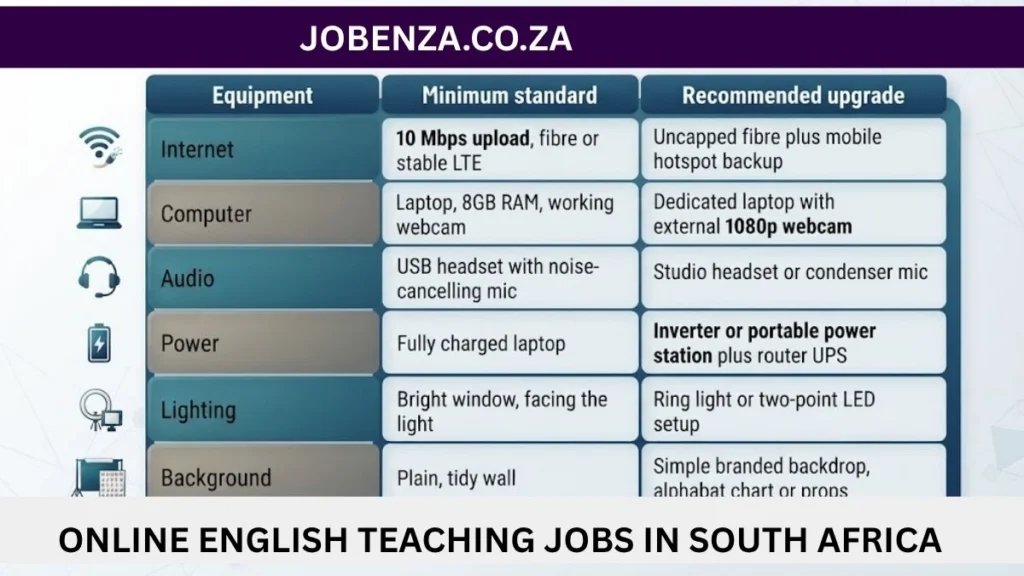
Load shedding remains a scheduling risk, so build redundancy before you accept bookings. A modest inverter plus a router UPS protects your income and your ratings during outages.
Cancelled classes carry financial penalties on most platforms. Reliability is a competitive advantage.
2.4 Soft Skills That Get You Rebooked
- High energy on camera. Enthusiasm reads as competence to nervous learners.
- Clear, slow articulation. Not louder — slower and better structured.
- Cultural sensitivity. Learn what topics land well with different student markets.
- Patience with silence. Give learners the space to produce language themselves.
Section 3: Top International and Local Companies Hiring South African English Tutors
The market splits into three models: conversation platforms (easy entry, lower rates), marketplaces (you set your price), and structured academies (fixed curriculum, steadier hours).
Understanding remote esl jobs south africa pay rates means understanding these models, because pay is driven by the model far more than by your talent.
Below are the best platforms for online english tutors based in South Africa in 2026.
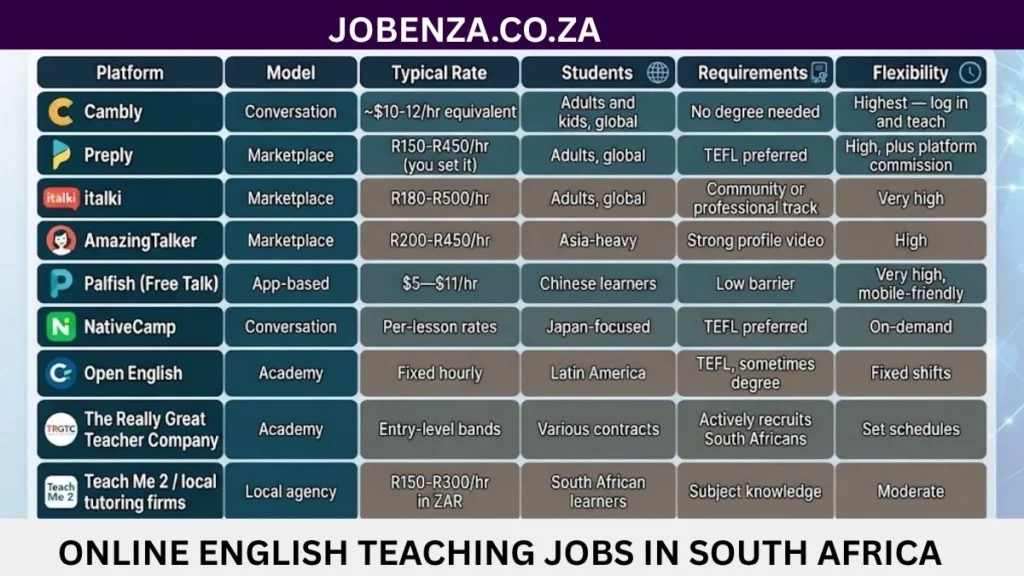
A few honest notes on this market.
Location-based pay is real. Several platforms benchmark rates by the tutor’s country, which means South Africans are sometimes offered less than North American applicants for identical work.
Fight this by moving toward marketplaces where you set the rate.
Chinese kids’ platforms are no longer the goldmine they were before 2021 regulation. Some apps still hire, but rates and stability have dropped sharply.
Do not build an entire income around one Chinese-market app.
Local demand is underrated. South African parents pay well for matric English, essay writing and university application support, and they pay in rand with no forex admin.
A blended portfolio, two international platforms plus a handful of local private students, is the most resilient structure in 2026.
Section 4: Step-by-Step Guide to Building a Standout Tutor Profile and Passing Video Auditions
Most applicants fail at presentation, not ability. Follow this sequence.
Step 1: Define One Clear Niche
Generic tutors compete on price. Specialists compete on value.
Pick a lane: business English for professionals, IELTS preparation, young learners aged 5 to 10, pronunciation coaching, or interview English.
Your niche becomes your headline.
Step 2: Write a Headline That Sells an Outcome
Weak: “Friendly English teacher from South Africa.”
Strong: “IELTS Speaking Coach — Move from Band 6 to Band 7.5 in 12 Weeks.”
Learners buy results, not personalities.
Step 3: Structure Your Bio in Three Blocks
- Who you help — name the exact learner and their problem.
- How you teach — your method, materials and lesson structure.
- Proof — certification, hours taught, results achieved.
Keep paragraphs short. Most students read your profile on a phone.
Step 4: Record a Profile Video That Converts
Your video is the single biggest booking driver. Aim for 60 to 90 seconds.
- Open with a smile and a direct greeting in the first three seconds.
- State your niche and who you help.
- Show one micro-teaching moment, such as correcting a common pronunciation error.
- Speak slower than feels natural and use visible hand gestures.
- Close with a clear invitation to book a trial lesson.
Film in good natural light. Record it ten times if needed; the tenth take is always the one you use.
Step 5: Prepare for the Demo Lesson
Academies almost always require a mock class, usually 10 to 20 minutes. Graders look for specific behaviours.
- TTT versus STT: Keep teacher talking time low. The student should speak most of the lesson.
- Clear instructions: Give one instruction at a time, then check understanding.
- Error correction: Use gentle recasting rather than blunt corrections.
- Props and visuals: Flashcards, a whiteboard or realia show preparation instantly.
- Warm-up and wrap-up: Always open with rapport and close with a recap.
Step 6: Price Strategically at Launch
Start slightly below your target rate to gather your first 10 to 15 reviews. Then raise your price in small increments every few weeks.
Reviews, not rates, are your early currency.
Step 7: Optimise Your Availability
Open your calendar during peak demand windows for your target market. Asian evenings and European afternoons convert best from South Africa.
Consistency in your calendar earns you algorithmic visibility on most platforms.
Section 5: Unlocking Daily Remote Opportunities With jobenza.co.za
Finding the roles is often harder than doing them. Openings appear and close within days, agency contracts are advertised quietly, and scam listings clutter the results.
That is exactly the gap jobenza.co.za was built to close.
jobenza.co.za is a South African-focused job portal where remote, hybrid and on-site vacancies are gathered in one place and updated continuously. Instead of refreshing ten different platform career pages, you check one hub.
Here is how tutors and remote workers get the most out of it.
- Daily verified listings. New remote and education vacancies are posted regularly, so you apply while roles are still open rather than weeks late.
- Filter by region and work type. Search specifically for remote and work-from-home roles, or narrow by province if you want hybrid options near Durban, Johannesburg or Cape Town.
- Beyond ESL. Online teaching pairs naturally with transcription, virtual assistance, customer support and content writing. jobenza.co.za lists these adjacent remote gigs too.
- Side hustle to full-time pathways. Many tutors start part-time and scale up. The portal makes it easy to track full-time digital education roles as they appear.
- Direct applications. Apply straight from the listing instead of chasing dead links across the internet.
- Scam awareness. Never pay a fee to be placed in a teaching role. Legitimate employers do not charge application fees, and jobenza.co.za helps you compare listings against real market norms.
Make it a habit. Ten minutes on jobenza.co.za each morning, before you open your teaching platforms, keeps a steady flow of opportunities moving through your pipeline.
Bookmark it, check it daily, and apply early. Speed wins remote roles.
Section 6: Maximising Your Income — Independent Tutoring vs Platform Teaching
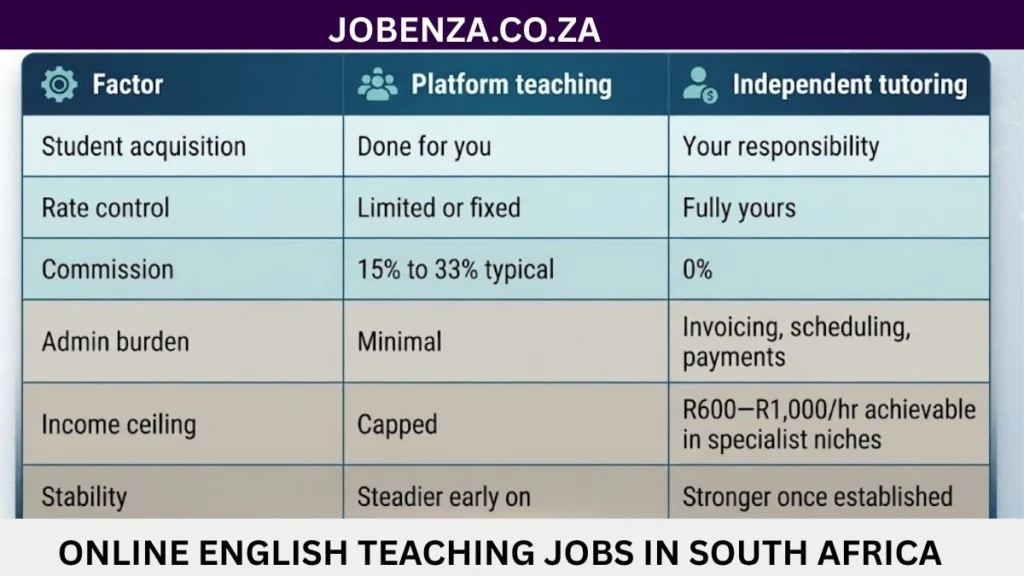
Platforms are a fantastic starting point and a poor final destination. Understanding the trade-off is how you double your rate.
The Two Models Compared
The Hybrid Strategy That Actually Works
Do not choose. Sequence.
- Months 1 to 3: Teach on one or two platforms. Build hours, reviews and confidence.
- Months 4 to 6: Identify your best-fit students and your strongest niche. Raise your platform rate.
- Months 7 onward: Launch a simple independent offer alongside platform work.
Never poach students directly off a platform. It breaks the terms of service and can get you removed. Build your independent pipeline separately.
Building Independent Demand
- Package your lessons. Sell blocks of 10 lessons rather than single sessions. Cash flow improves immediately.
- Use social proof. Post short teaching clips and student wins on Instagram, TikTok or LinkedIn.
- Target corporates. Local and international companies pay premium rates for business English and presentation coaching.
- Serve local demand in rand. Matric English, essay coaching and university applications are consistently in demand.
- Add group classes. Four students at R150 each beats one at R400 for the same hour.
Protect Your Earnings
- Keep a simple income spreadsheet from day one.
- Set aside a portion of every payout for tax.
- Compare withdrawal fees across payment providers; they quietly eat 3% to 7% of forex income.
- Diversify across at least two income sources so a single platform policy change cannot wipe out your month.
Frequently Asked Questions
Do I need to pay tax on income from online English teaching in South Africa?
Yes. Money earned from foreign platforms is still taxable income in South Africa if you are tax resident here.
Most online tutors work as independent contractors rather than employees, which usually means registering with SARS as a provisional taxpayer and filing twice a year. Keep records of every payout, your equipment costs, internet bills and TEFL fees, since legitimate business expenses can be deducted.
Speak to a registered tax practitioner once your teaching income becomes regular.
How do I get paid in rand, and what fees should I expect?
Most international platforms pay in USD via PayPal, Payoneer or Wise, and some use direct bank transfers.
You then convert to rand, which triggers both a platform withdrawal fee and a forex conversion margin. Compare providers carefully, because the combined cost typically ranges from around 3% to 7% of the payout.
Withdraw in larger batches rather than weekly to reduce fixed fees.
What hours will I actually work from South Africa?
That depends entirely on your student market, and this is the biggest advantage of the job.
Asian markets peak roughly 01:00 to 07:00 SAST for early mornings and again in South African early evenings. European learners book afternoons and early evenings SAST, while Middle Eastern learners suit late afternoons. Latin American markets often align with South African late evenings.
You choose the market that matches the life you want.
Can I really get hired without a university degree?
Yes, on many platforms. Conversation-focused platforms and open marketplaces routinely accept tutors with a 120-hour TEFL certificate and no degree.
Degrees matter most for accredited academies, exam-prep contracts and corporate training work. Build hours and reviews first, and the degree requirement becomes far less limiting.
How much can a beginner realistically earn in the first year?
Be realistic in month one and ambitious by month twelve.
Entry-level tutors commonly earn in the R130 to R200 per hour range while building reviews. Experienced, specialised tutors on marketplaces frequently reach R300 to R450 per hour, and independent IELTS or business English coaches can charge considerably more.
Working around 20 hours a week at intermediate rates puts a meaningful second income within reach, and full-time tutors do build full-time livings from it.
Is my South African accent a problem?
For the vast majority of employers and learners, no. Standard South African English is clear and easy for learners to follow.
A small number of platforms still filter by passport or by “native speaker” country lists. Skip those and focus your energy on the many platforms that hire South Africans openly.
Conclusion: Your Virtual Classroom Is Waiting
The barrier to entry has never been lower, and the demand has never been steadier. A 120-hour TEFL certificate, a decent headset, reliable fibre and a well-shot profile video are genuinely enough to start earning within weeks.
Start small and stay consistent. Get certified, build your profile, take the low-rate lessons that earn your first reviews, then raise your price with confidence.
Diversify across two platforms, add local private students in rand, and protect yourself against load shedding and platform policy changes.
The tutors who succeed are not the most qualified. They are the most consistent, the most reliable and the best prepared.
Your next step is the simplest one. Head to jobenza.co.za and browse today’s fresh remote and teaching listings.
New verified vacancies, flexible gigs and full-time digital roles are added regularly, so make jobenza.co.za your daily first stop. Apply early, apply often, and start building the flexible career you actually want.