

Every shopping centre, hospital ward, hotel room, factory floor and family home in this country needs one thing before anything else works: cleanliness. That single reality is why cleaning jobs in south africa remain one of the most reliable entry points into formal employment, even in a tough labour market. While other sectors freeze hiring, cleaning teams keep recruiting because dirt does not take a holiday.
The demand is not accidental. Post-pandemic hygiene standards, stricter health and safety compliance, and the growth of outsourced facilities management have turned cleaning into a professional service industry rather than casual labour.
Contract cleaning companies now hold multi-year contracts with banks, universities, mines and government departments. Each of those contracts needs staff, supervisors and shift teams.
This guide is written for the person who wants work this month, not someday. You will find the real role types, current legal wage floors gazetted for 2026, honest salary ranges, a step-by-step CV method that works without matric-level English, and a practical way to spot scams before they cost you money.
By the end, you will know exactly where to look, what to say, and what you are legally worth.
Section 1: Understanding the Cleaning Sector in South Africa
The cleaning industry is not one market. It is three, and they pay differently, hire differently, and value different skills. Knowing which one you are applying into changes your whole approach.
Residential and Domestic Cleaning
This is the largest and oldest segment. It covers household cleaners, live-in helpers, nannies with cleaning duties, and garden-plus-house combinations.
Most hiring happens through referrals, community WhatsApp groups, church networks and neighbourhood pages. Work is often part-time across two or three employers.
The upside is flexibility and fast placement. The downside is weaker job security, so always insist on a written contract, even for two days a week.
Commercial Cleaning
Commercial work covers offices, malls, schools, banks, retail stores, airports and government buildings. It is dominated by contract cleaning companies who win a site contract and then staff it.
This is where commercial Cleaning Jobs actually exist, because there is a ladder: cleaner, team leader, supervisor, site manager, area manager.
Employment here is formal. You get a payslip, UIF, leave and often provident fund contributions.
Industrial and Specialised Cleaning
This is the highest-paying tier. It includes warehouse and factory sanitation, food-production hygiene, hospital and clinic infection control, mine change-house cleaning, and high-rise window work.
These roles require training, medical fitness and sometimes certification. In return, they pay well above general cleaning rates.
A worker who moves from an office site into food-grade sanitation can realistically increase earnings by 30% to 60% within two years.
Section 2: Major Types of Cleaning Roles Available
Job titles matter. Searching the wrong words is the number one reason good candidates miss vacancies. Below are the real roles advertised across South Africa in 2026.
1. Office Cleaner / General Assistant
The volume leader. Duties include desk sanitising, restroom hygiene, kitchen areas, refuse removal and floor care.
office cleaner jobs gauteng is one of the busiest search categories in the country, driven by Sandton, Rosebank, Midrand, Centurion and the Pretoria CBD corporate belt.
Shifts are often early morning (05:00–09:00) or evening after office hours, which makes it possible to hold two contracts.
2. Domestic Worker / Household Helper
Covers cleaning, laundry, ironing, cooking and light childcare. Demand is steady in Johannesburg’s northern suburbs, Cape Town’s southern suburbs and Durban’s Umhlanga and Westville areas.
Searches for domestic worker vacancies south africa spike in January and again in September, when families restructure household help.
Live-in roles include accommodation, but the law limits what an employer may deduct for it.
3. Hotel Housekeeper / Room Attendant
Hospitality housekeeping is measured by room targets, usually 12 to 16 rooms per shift depending on the property grade.
Cape Town, Durban’s beachfront, the Garden Route and Kruger-area lodges hire heavily from September to April.
Tips and service charges can add meaningfully to take-home pay at four- and five-star properties.
4. Warehouse and Industrial Sanitation Worker
Found in logistics parks, cold storage, FMCG plants and manufacturing. Duties involve chemical dilution, machine cleaning, floor scrubbers and waste handling.
Employers value anyone who understands COSHH-style chemical safety, colour-coded equipment systems and basic record keeping.
Physical fitness, steel-toe boots and shift flexibility are usually non-negotiable.
5. Hospital and Healthcare Cleaner
Infection prevention and control (IPC) cleaning is a specialised discipline. You clean to a protocol, not to appearance.
Private hospital groups and public clinics both recruit continuously, and the work is far more secure than general contracts.
6. On-Demand and Gig Cleaning
App-based platforms changed the entry route completely. Workers register, get vetted, and accept bookings near them.
Interest in sweepstart opportunities cape town reflects this shift, and it is worth clearing up the spelling: the well-known Cape Town platform is SweepSouth, and its registered cleaners are called SweepStars.
Gig work is excellent for building a client base fast, but it is not permanent employment, so treat it as a bridge or a supplement.
7. Specialised Cleaning Niches
Consider these once you have 12 months of experience:
- Carpet and upholstery deep cleaning
- Post-construction and builders’ clean-up
- High-pressure and facade washing
- Rope-access high-rise window cleaning
- Crime-scene and trauma cleaning (highly paid, licensed)
- Solar panel and industrial equipment cleaning
Section 3: Expected Salaries and Wage Guidelines
Wages in this sector are governed by law, not goodwill. Knowing the numbers protects you.
The Legal Floor for 2026
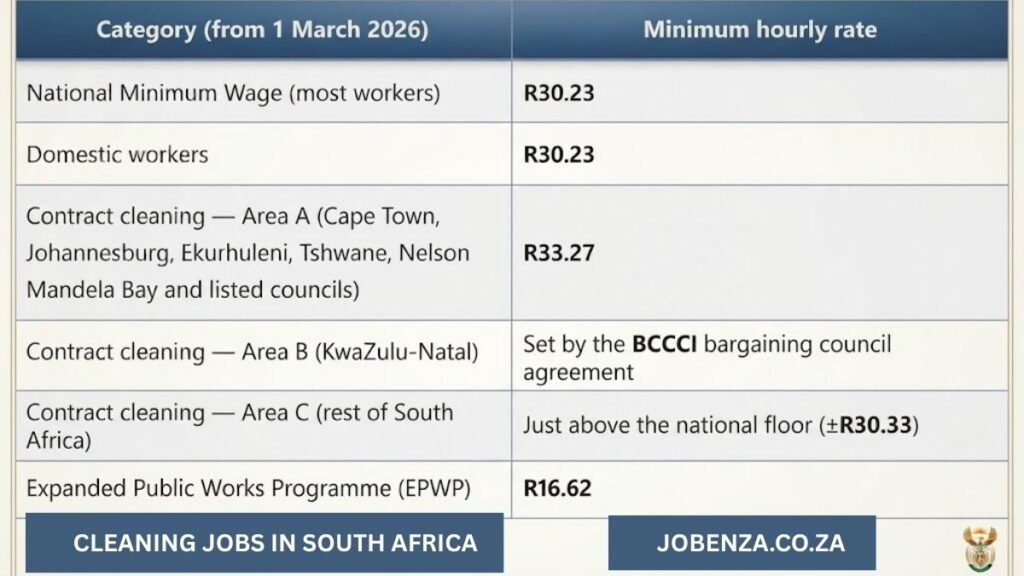
From 1 March 2026, the National Minimum Wage is R30.23 per ordinary hour, up from R28.79 — an increase of roughly 5%. Domestic workers and farm workers are entitled to the same rate.
Contract cleaning falls under Sectoral Determination 1, which sets a rate higher than the national floor in the major metros.
Three rules every cleaner should memorise:
- If you work less than four hours in a day, you must still be paid for four hours.
- A 45-hour week at the national minimum equals roughly R5 890 per month before deductions.
- For live-in domestic workers, an accommodation deduction is capped at 10% of the wage.
Typical Market Salary Ranges
The legal minimum is the floor, not the market. These are realistic advertised ranges in 2026, before deductions.
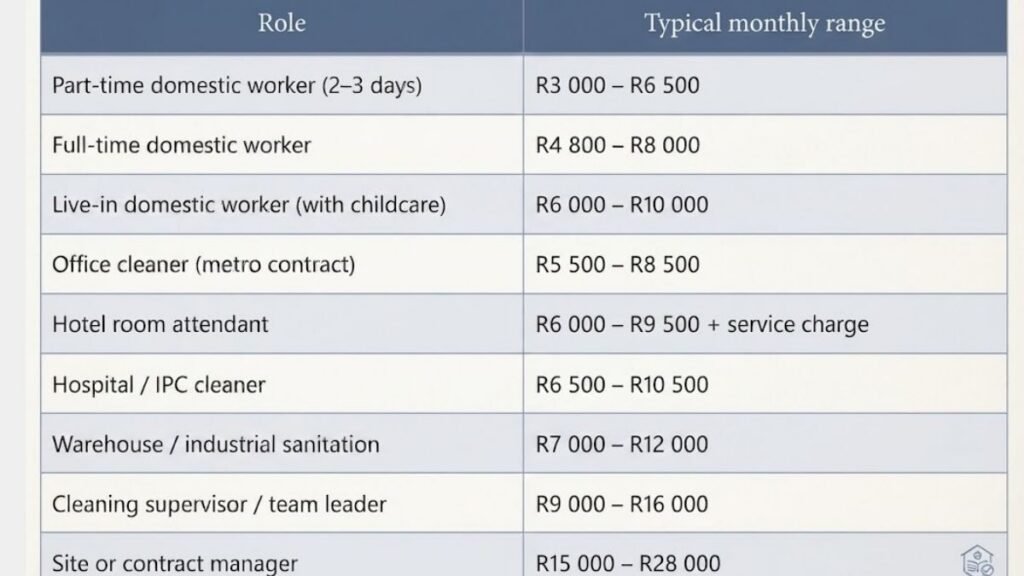
Pay varies by province. Gauteng and the Western Cape sit at the top; Limpopo, Mpumalanga and the Eastern Cape typically sit 10% to 20% lower for identical duties.
What Should Be on Your Payslip
Check for these every single month:
- Gross wage and hours worked
- UIF deduction of 1% (your employer adds another 1%)
- Overtime at 1.5× the normal rate
- Any provident fund or union contribution, clearly itemised
If your employer pays below the legal minimum, you can lodge a complaint at your nearest Department of Employment and Labour centre. Back-pay can be ordered.
Section 4: How to Craft a Winning CV and Secure the Interview
Most entry-level cleaning positions are lost at the paperwork stage, not the interview. Fix the paperwork and your call-back rate jumps.
Step 1: Build a One-Page CV
Never send more than one page for a cleaning role. Recruiters screen dozens per vacancy in minutes.
Include, in this order:
- Full name, cellphone number, email, suburb and city
- A two-line summary of who you are and what you clean
- Work experience, most recent first
- Skills and equipment you can operate
- Education and any certificates
- Two contactable references with permission
Step 2: Write a Summary That Sells Reliability
Employers in this sector hire for trust and attendance above all else. Say so directly.
Example: “Reliable general cleaner with 4 years’ experience in office and retail sites. Trained in chemical dilution and colour-coded systems. Never missed a shift in 2 years.”
That sentence beats any generic paragraph about being “hardworking and passionate”.
Step 3: Turn Duties into Achievements
Weak: “Cleaned offices.”
Strong: “Maintained a 1 200 m² open-plan office and 6 restrooms daily for a team of 90 staff, with zero client complaints in 18 months.”
Numbers create credibility. Use floor sizes, room counts, staff numbers and years.
Step 4: List Practical, Verifiable Skills
Employers scan for these keywords:
- Floor scrubbers, buffers and polishers
- High-pressure washers
- Colour-coded cloth and mop systems
- Chemical dilution and safe storage
- Waste segregation and recycling
- Basic English, isiZulu, Afrikaans, Sesotho — list every language you speak
Step 5: Prepare Your Document Pack
Have these scanned and saved on your phone, ready to WhatsApp within minutes:
- Green barcoded ID or smart ID card
- Proof of residence
- SARS tax number (if you have one)
- Any certificates: first aid, health and safety, hospitality training
- Police clearance if you are targeting domestic or hospital work
Candidates who send documents the same day get hired first. That is the whole trick.
Step 6: Handle the Interview
Arrive 15 minutes early, dressed neatly and plainly. Bring a printed CV even if you emailed it.
Expect three questions almost every time:
- “Why did you leave your last job?” — answer briefly and never insult a former employer.
- “How do you handle a client complaint?” — describe listening, fixing it, and reporting it.
- “Are you available for shifts and weekends?” — be honest, because false availability ends contracts fast.
Ask one question back: about the site, the team size, or the training provided. It signals real interest.
Step 7: Follow Up Properly
Send one short message three working days later. Polite persistence works in this industry, and many placements happen exactly this way.
Section 5: Your Daily Gateway to Employment — Why Visit jobenza.co.za
Searching for work is exhausting when listings are scattered across a dozen sites, half of them expired. That is the problem jobenza.co.za was built to solve.
jobenza.co.za is a South African recruitment portal focused on the roles ordinary job seekers actually apply for — cleaning, general work, security, drivers, hospitality, admin and retail.
Instead of scrolling endlessly, you get a filtered, current view of what is open right now.
What You Get on jobenza.co.za
- Daily fresh listings, so you are not applying to vacancies that closed weeks ago
- Filter by province and city — Gauteng, Western Cape, KwaZulu-Natal, Free State and beyond
- Filter by role type, including entry-level cleaning positions that need no formal qualification
- Direct application details on each post, so you apply straight to the employer
- Clear posting dates so you can prioritise the newest opportunities first
- Mobile-friendly pages that load fast on limited data
How to Use It Properly
Make jobenza.co.za part of a daily 10-minute routine, not an occasional visit.
- Check the site every morning before 08:00, when new listings go live.
- Filter to your city and role, then open the three newest matches.
- Apply the same day using your pre-saved CV and document pack.
- Keep a simple note of where and when you applied, so you can follow up on day three.
Job seekers who apply within 24 hours of a listing appearing sit near the top of the pile. Those who apply after a week are often too late.
If you are serious about finding work this month, bookmark jobenza.co.za and treat it as your first stop each morning.
Section 6: Top Platforms, Agencies and Staying Safe from Scams
A layered search beats a single channel. Use all of these together.
Where to Search Online
- jobenza.co.za — daily curated South African listings
- Indeed South Africa, PNet, Careers24 and CareerJunction — large national boards
- Gumtree and Facebook Marketplace — strong for domestic and part-time work, but verify carefully
- LinkedIn — best for supervisor and facilities management roles
- SweepSouth and similar app platforms — gig-based residential cleaning
Contract Cleaning Companies Worth Approaching Directly
Large facilities management and contract cleaning firms recruit constantly. Walk in with a CV, or apply through their careers pages.
Target the companies that hold contracts at malls, hospitals, universities and corporate parks in your area. Ask the on-site supervisor which company holds the contract — that single question opens more doors than any job board.
How to Find Cleaning Work in Durban and Other Coastal Hubs
how to find cleaning work in durban deserves its own approach, because KwaZulu-Natal has its own bargaining council for contract cleaning.
- Target hospitality along the Golden Mile, Umhlanga and Ballito, especially before the December season.
- Approach logistics and warehousing employers near the Durban port and Prospecton.
- Register with local agencies in Pinetown, Phoenix and Chatsworth.
- Ask about BCCCI-linked rates, which govern contract cleaning wages in the province.
Apply the same logic in Cape Town (hospitality and offices), Gqeberha (automotive plants) and Bloemfontein (education and government sites).
Spotting and Avoiding Job Scams
Cleaning job seekers are targeted heavily. Learn the warning signs.
Red flags to walk away from:
- Any request for money — for registration, training, uniforms, “placement” or transport
- Job offers made without any interview at all
- Vague companies with no physical address or landline
- Communication only via free email addresses or unnamed WhatsApp numbers
- Requests for your bank card, PIN or SARS eFiling password
- Pressure to “confirm today or lose the position”
Safety rules that protect you:
- A legitimate recruiter is paid by the employer, never by you.
- Verify the company name on Google and check the physical address.
- For domestic roles, tell a family member where you are going and share the address.
- For a first interview at a private home, meet in a public place or bring someone with you.
- Get every offer in writing before resigning from current work.
Trust the discomfort. If something feels rushed or secretive, it usually is.
Frequently Asked Questions
What qualifications do I need for cleaning jobs in South Africa?
Most entry-level cleaning positions require no formal qualification. Employers look for a valid ID, contactable references, physical fitness and reliability. Certificates in first aid, health and safety, or hospitality training will move you ahead of other candidates, and are essential for hospital or industrial roles.
What is the minimum wage for a domestic worker in 2026?
Domestic workers are entitled to the National Minimum Wage of R30.23 per hour from 1 March 2026. That equals roughly R5 890 per month for a 45-hour week. If you work fewer than four hours on a day, you must still be paid for four hours.
Do contract cleaners earn more than domestic workers?
Usually, yes. Contract cleaning in Area A metros carries a sectoral minimum of R33.27 per hour, above the general floor. Commercial and industrial sites also offer UIF, paid leave, overtime and promotion paths that domestic work often lacks.
How do I find office cleaner jobs in Gauteng quickly?
Search daily on jobenza.co.za and the major boards, apply within 24 hours of a listing appearing, and approach contract cleaning companies operating in Sandton, Midrand, Centurion and the Pretoria CBD directly. Early-morning and evening shifts have the highest turnover, which means the most frequent openings.
Is gig cleaning work through apps worth it?
It can be, especially in Cape Town and Johannesburg where demand is high. Platforms give you fast access to clients without a formal CV. However, income fluctuates and you are usually not a permanent employee, so treat app work as a bridge to a stable contract rather than a destination.
Can I do cleaning work without matric?
Yes. The majority of cleaning vacancies do not require matric. Focus your CV on experience, reliability, equipment skills and languages spoken. Many supervisors in this industry started as general cleaners without matric and were promoted internally.
How can I move from cleaner to supervisor?
Volunteer for training, learn chemical safety and equipment operation properly, keep a perfect attendance record, and tell your manager you want to grow. Most contract cleaning companies promote from within, and a team leader role is typically the first step within 12 to 24 months.
Conclusion: Your Next Shift Starts With One Application
The cleaning industry rewards the consistent, not the lucky. Sites need staff every single day, contracts turn over constantly, and employers are far more concerned with whether you arrive on time than with what qualifications you hold.
You now know the three market segments, the roles that pay best, the legal wage floors for 2026, and the CV structure that gets call-backs. What separates a job seeker from an employee is speed of application.
So do the simple thing today. Update your one-page CV, scan your ID and references onto your phone, and start applying.
Visit jobenza.co.za right now, filter by your city, and open the newest cleaning listings. Fresh vacancies are added daily — and the person who applies first is usually the person who gets called.
Your next payslip is one application away.