

Accounting jobs in South Africa are booming in 2026. Businesses need skilled number-crunchers more than ever. New tax rules, digital tools, and tighter SARS compliance checks mean companies are hiring fast.
Whether you’re a matric leaver, a career-changer, or a seasoned bookkeeper, this guide has what you need. We’ll cover salaries, qualifications, software skills, and future trends. By the end, you’ll know exactly what steps to take next.
Let’s dive in.
Why Accounting Is a Smart Career Choice in South Africa

Money matters never go out of style. Every business, big or small, needs someone to manage its books. That’s why accounting jobs in South Africa stay in demand, even when other industries slow down.
Here’s what’s driving hiring right now:
- Stricter SARS compliance rules. Businesses need experts who won’t get them into tax trouble.
- Small business growth. More SMEs mean more bookkeeping and accounting work.
- Digital transformation. Companies are moving to cloud accounting and need staff who understand it.
- Global remote work. UK, EU, and US firms are hiring South African accountants for remote roles. Our time zone and English skills make us attractive candidates.
Pro-Tip: Don’t just chase big cities. Many regional firms in places like Bloemfontein or Nelspruit struggle to find qualified staff. Less competition can mean faster promotions.
Where the Jobs Are: Industry Demand Breakdown
Not all accounting jobs look the same. Different industries need different skills. Here’s where the demand is strongest.
Banking and Financial Services
Banks and insurers need accountants for financial reporting, risk analysis, and regulatory compliance. This sector pays well but expects strong technical skills and often a CA(SA) qualification for senior roles.
Retail and FMCG
Retail chains need cost accountants and financial analysts to track margins, manage stock value, and control expenses. This industry moves fast, so accountants here need to be comfortable with tight deadlines.
Mining and Manufacturing
These sectors need cost and management accountants who understand production expenses. Jobs are often based outside major metros, which can mean less competition for applicants.
Public Sector and Government
Municipalities, SOEs, and government departments hire accountants for budgeting and auditing. Job security tends to be high, though pay can be lower than private sector roles.
Remote and Outsourced Accounting
This is the fastest-growing space. International firms outsource bookkeeping and accounting to South African professionals. If you’re comfortable with Xero and cloud tools, this path can pay in foreign currency.
Pro-Tip: Add “remote-ready” skills to your CV, like experience with Xero, Zoom meetings across time zones, and asynchronous communication. Recruiters for international roles look for this specifically.
Types of Accounting Jobs You Can Pursue
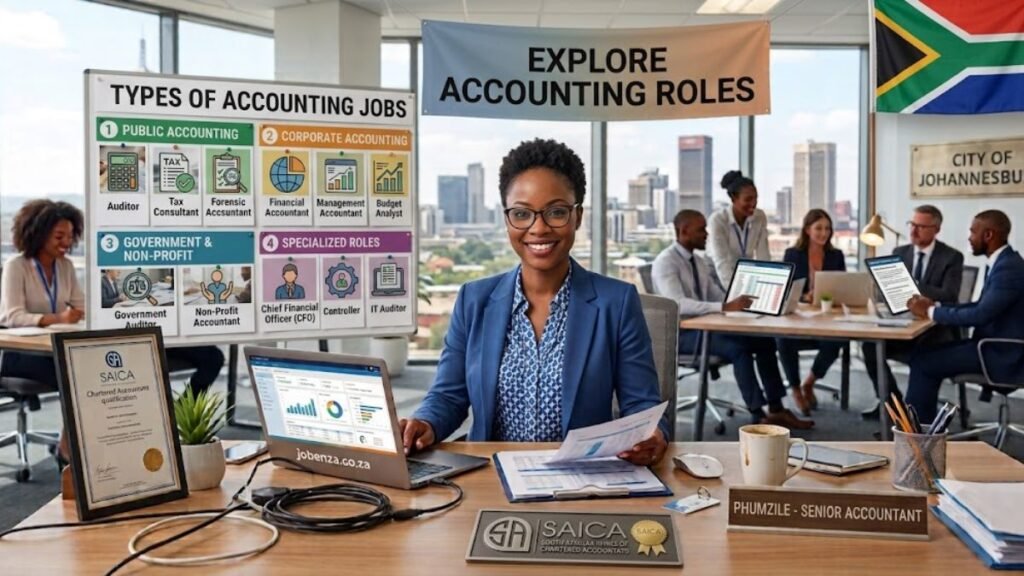
Accounting isn’t one job. It’s a whole career ladder. Here are common roles you’ll find advertised:
- Bookkeeper – Records daily transactions, reconciles accounts.
- Accounting Clerk – Handles invoices, data capture, and basic reports.
- Accountant – Prepares financial statements and manages ledgers.
- Tax Practitioner – Registered with SARS to handle tax returns and compliance.
- Management Accountant – Focuses on budgets, forecasts, and internal decision-making.
- Financial Analyst – Studies numbers to guide business strategy.
- Auditor – Checks that financial records are accurate and compliant.
- Chartered Accountant (CA(SA)) – The top qualification, opening doors to senior leadership.
- Payroll Administrator – Manages salaries, UIF, and PAYE submissions.
- Financial Manager / CFO – Oversees the entire finance function of a company.
Each role needs different qualifications. Let’s break those down next.
Education Requirements: SAICA, SAIPA, and Beyond

Your qualification path shapes your entire career. South Africa has clear routes, each recognized by professional bodies.
The SAICA Route (Chartered Accountant)
This is the gold standard. Steps include:
- Complete a BCom degree accredited by SAICA.
- Complete a postgraduate CTA (Certificate in the Theory of Accounting).
- Pass the Assessment of Professional Competence (APC) board exam.
- Complete SAICA articles (three years of supervised training at an accredited firm).
This path takes about 6-7 years but leads to the highest-paying roles.
The SAIPA Route (Professional Accountant)
SAIPA offers a faster, practical path:
- Complete a relevant accounting diploma or degree.
- Complete a learnership with an approved SAIPA mentor.
- Pass the Professional Evaluation exam.
This route suits people who want to work in SME accounting or run their own practice.
CIMA (Management Accounting)
CIMA is a globally recognized qualification focused on business and management accounting. It’s a strong choice if you want to work internationally or in corporate finance.
Short Courses and Certificates
Not ready for a full degree? Many colleges offer NQF-aligned certificates in bookkeeping or payroll administration. These can get your foot in the door within months, not years.
Pro-Tip: If you’re switching careers later in life, SAIPA’s practical route is often faster than starting a full CA(SA) journey. Match your qualification path to your timeline and goals.
Salary Benchmarks: What You Can Earn (2026)
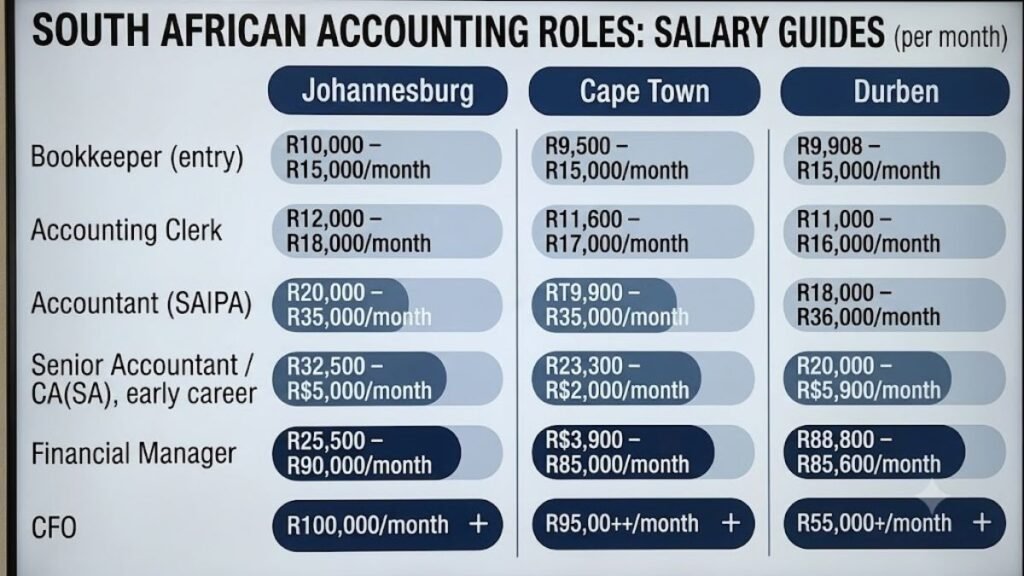
Salaries vary by experience, qualification, and city. Here’s a general guide based on current market trends.
| Role | Johannesburg | Cape Town | Durban |
|---|---|---|---|
| Bookkeeper (entry) | R10,000 – R15,000/month | R9,500 – R14,000/month | R9,000 – R13,500/month |
| Accounting Clerk | R12,000 – R18,000/month | R11,500 – R17,000/month | R11,000 – R16,000/month |
| Accountant (SAIPA) | R20,000 – R35,000/month | R19,000 – R33,000/month | R18,000 – R30,000/month |
| Senior Accountant / CA(SA), early career | R35,000 – R55,000/month | R33,000 – R52,000/month | R30,000 – R48,000/month |
| Financial Manager | R55,000 – R90,000/month | R52,000 – R85,000/month | R48,000 – R80,000/month |
| CFO | R100,000+/month | R95,000+/month | R85,000+/month |
Note: Johannesburg typically pays the most due to corporate head offices. Cape Town follows closely, with growing demand in tech and finance. Durban offers slightly lower pay but a lower cost of living.
Pro-Tip: Remote jobs for international clients often pay in USD, GBP, or EUR. This can mean earning 20-40% more than a local salary for the same skill level.
Critical Software Skills You Need
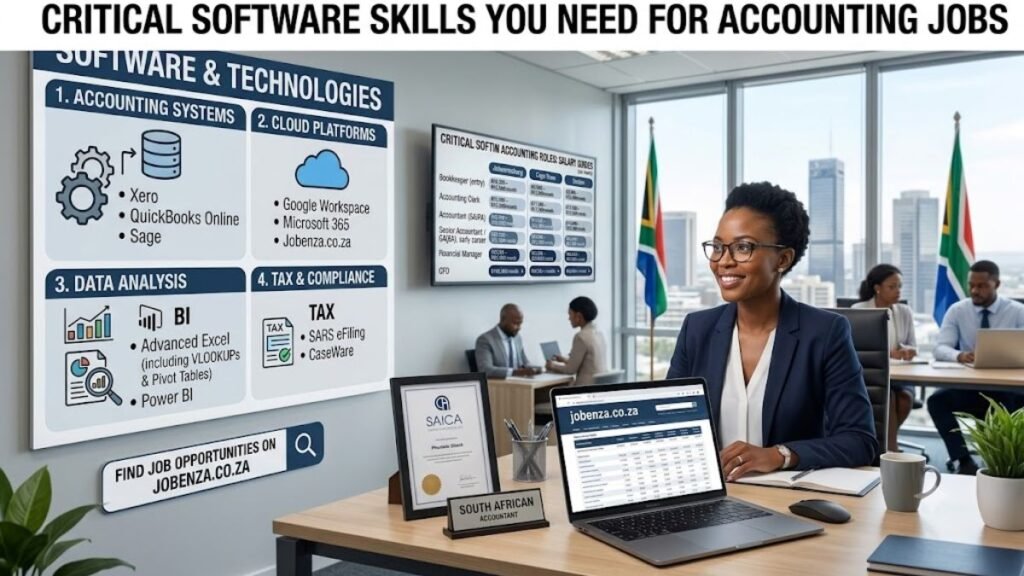
Modern accounting jobs in South Africa expect strong software skills. Here’s what to learn.
Sage (Sage 50, Sage Evolution, Sage Payroll)
Sage is widely used by South African SMEs and mid-sized firms. Knowing Sage Payroll is especially valuable, since many jobs require accurate PAYE and UIF processing.
Pastel (Sage Pastel Partner)
Pastel remains popular with smaller businesses and accounting practices. Many bookkeeping jobs still list Pastel as a required skill.
Xero
Xero is the top choice for cloud accounting and remote work. If you want international or remote accounting jobs, Xero experience is often non-negotiable.
Excel and Google Sheets
Don’t skip the basics. Advanced Excel skills, like pivot tables and VLOOKUPs, are still tested in interviews.
Emerging Tools
AI-powered reconciliation tools and cloud ERP systems (like Sage Intacct or Xero’s AI features) are growing fast. Learning these now puts you ahead of the curve.
Pro-Tip: Get free certification. Xero and Sage both offer free online training and certificates. Add these to your CV and LinkedIn profile immediately.
Your Career Roadmap: From Entry-Level to CFO
Use this table to map out your next five to fifteen years.
| Stage | Typical Qualification | Experience Needed | Typical Role | Estimated Monthly Salary |
|---|---|---|---|---|
| 1. Foundation | Matric + short course | 0 years | Accounting Clerk | R8,000 – R15,000 |
| 2. Building Skills | Diploma or degree in progress | 1-2 years | Bookkeeper / Junior Accountant | R15,000 – R22,000 |
| 3. Qualifying | SAIPA learnership or SAICA articles | 2-4 years | Trainee Accountant | R18,000 – R30,000 |
| 4. Professional | SAIPA or CA(SA) qualified | 4-6 years | Accountant / Tax Practitioner | R30,000 – R50,000 |
| 5. Senior Specialist | CA(SA) or equivalent | 6-10 years | Senior Accountant / Financial Analyst | R50,000 – R80,000 |
| 6. Leadership | CA(SA) + management experience | 10-15 years | Financial Manager | R80,000 – R110,000 |
| 7. Executive | CA(SA) + strategic experience | 15+ years | CFO / Finance Director | R110,000+ |
Pro-Tip: Don’t wait until you’re “fully qualified” to start networking. Join SAICA or SAIPA events while you’re still studying. Many articles positions are filled through referrals, not job ads.
How to Succeed: Advice You Won’t Find on Generic Job Boards
Build a CV That Passes the ATS Test
Many South African companies use Applicant Tracking Systems (ATS) to scan CVs. Use these tips:
- Include exact keywords from the job ad, like “financial reporting” or “SARS compliance.”
- Avoid tables and graphics in your actual CV file. They confuse ATS software.
- List software skills clearly: “Sage Payroll,” “Xero,” “Advanced Excel.”
Network With Purpose
Join SAICA and SAIPA LinkedIn groups. Attend local CPD (Continuous Professional Development) events. Many senior accountants get their next role through a contact, not a job board.
Choose Your Articles Firm Wisely
If you’re doing SAICA articles, choose a firm with strong training programs, not just a big name. Smaller firms sometimes offer broader hands-on experience.
Position Yourself for Remote Work
If you want remote accounting jobs, build a portfolio showing cloud software skills. Mention time zone flexibility and strong written English in your applications.
Pro-Tip: Ask to shadow a tax practitioner for a day, even informally. Understanding real SARS compliance work gives you an edge that textbooks can’t teach.
The Future of Accounting: AI and Automation in South Africa

Accounting is changing fast. Here’s what to expect.
What AI Is Already Doing
AI tools now handle routine bank reconciliations, data capture, and basic report generation. This means entry-level, repetitive tasks are shrinking.
What This Means for You
- Compliance-only roles are at risk. Simple data entry jobs may disappear over the next decade.
- Advisory skills are rising in value. Businesses want accountants who can explain numbers, not just record them.
- Tech skills are now essential. Comfort with AI tools, cloud software, and data analysis will set you apart.
How to Future-Proof Your Career
- Learn to interpret data, not just capture it.
- Build client-facing communication skills.
- Stay updated on SARS compliance changes, since this expertise can’t be fully automated.
- Get comfortable with AI tools instead of fearing them.
Pro-Tip: Frame yourself as a “financial advisor” who happens to be great with numbers, not just a data processor. This mindset shift matters more than any single software skill.
Frequently Asked Questions
1. What qualifications do I need for accounting jobs in South Africa?
It depends on the role. Entry-level jobs need a matric certificate and basic bookkeeping training. Professional roles need a SAIPA or SAICA qualification.
2. How much do accountants earn in South Africa?
Salaries range from around R10,000 a month for entry-level clerks to over R100,000 a month for CFOs, depending on experience and location.
3. Is Sage or Xero more important to learn?
Learn both if possible. Sage and Pastel are common in local SMEs, while Xero is preferred for remote and international roles.
4. Can I become an accountant without a degree?
Yes. SAIPA’s practical route and various NQF-aligned certificates offer paths into accounting without a full university degree.
5. Are remote accounting jobs available for South Africans?
Yes. Many UK, US, and EU companies hire South African accountants for remote bookkeeping and accounting roles, often paying in foreign currency.
6. How long does it take to become a CA(SA)?
Typically six to seven years, including your degree, CTA, board exams, and three years of articles.
7. What is SARS compliance, and why does it matter for my career?
SARS compliance means following South African tax laws correctly. Strong compliance knowledge makes you valuable to any employer.
8. Do I need to register as a tax practitioner?
Yes, if you want to prepare and submit tax returns professionally. Registration is done through SARS and a recognised controlling body.
9. Which industries hire the most accountants in South Africa?
Banking, retail, mining, and the public sector are consistently strong hirers, along with the growing remote/outsourced accounting sector.
10. Will AI replace accounting jobs in South Africa?
AI will replace some repetitive tasks, but advisory, analytical, and compliance expertise will remain in demand for years to come.
Final Thoughts
Accounting jobs in South Africa offer real stability and strong growth potential in 2026. The key is choosing the right qualification path, learning in-demand software like Sage, Pastel, and Xero, and staying ahead of AI trends.
Start where you are. Build your skills step by step. Whether your goal is a stable local role or a remote international position, the roadmap above can guide you there.
Ready for your next move? Browse the latest accounting job listings on Jobenza.co.za and take the next step in your career today.