

South Africa moves roughly three-quarters of its freight tonnage by road, and every pallet, fuel load and container that crosses the N1, N3 or N4 sits behind a qualified professional holding a heavy motor vehicle licence — which is exactly why code 14 driver jobs have become one of the most consistently advertised, best-protected and fastest-filled roles on the national employment market. Cross-border corridors into Zimbabwe, Botswana, Mozambique, Namibia and Eswatini have expanded steadily since the African Continental Free Trade Area came into force, while domestic e-commerce fulfilment has pushed line-haul volumes between Gauteng and the coastal ports to record levels. Fleet operators are not short of trucks. They are short of licensed, medically cleared, criminally vetted heavy vehicle drivers who can be trusted with a R2 million rig and R3 million of cargo. If you hold — or are working toward — a Code EC licence, you are holding a scarce asset, and this guide shows you exactly how to convert it into stable, well-paid work.
Section 1: The National Landscape — Where Code 14 Driver Jobs Are Concentrated
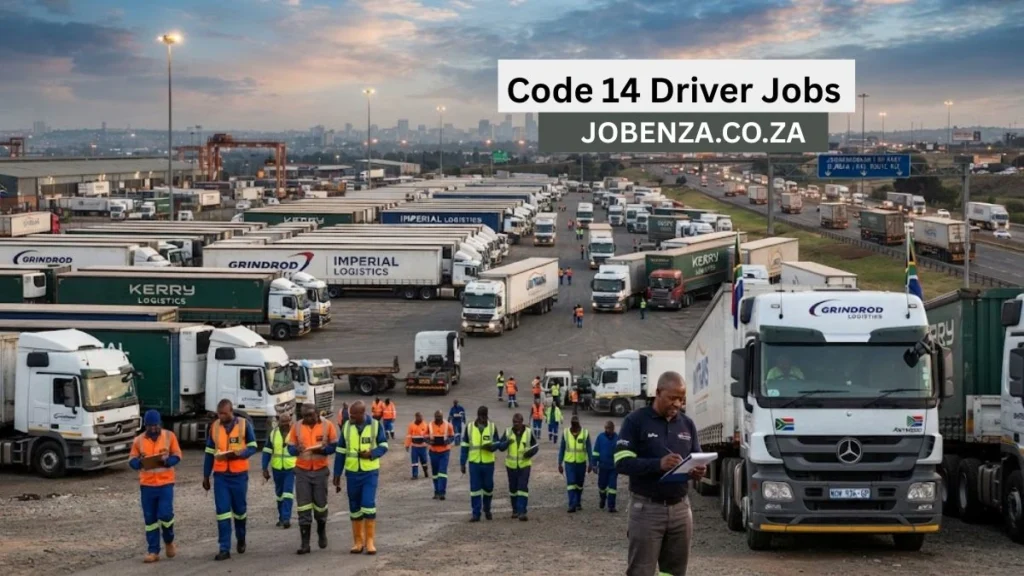
Code 14 driver jobs are advertised in every province, but three economic engines absorb the overwhelming majority of vacancies. Understanding where the work sits — and what kind of work it is — lets you target applications instead of scattering them.
Gauteng: The Inland Freight Heart
Gauteng generates and receives more freight than any other province despite having no coastline. City Deep in Johannesburg is the largest inland container terminal on the continent, and the industrial belts of Isando, Kempton Park, Alrode, Vanderbijlpark and Rosslyn run on constant heavy vehicle movement. Typical Gauteng roles include:
- Line-haul on the N3 corridor to Durban (roughly 570 km, run as a same-day turn or overnight)
- Container drayage between City Deep, Tambo Springs and the Rosslyn automotive cluster
- Fuel and chemical tanker distribution out of the Natref and Sasol depots
- Cement, steel and mining consumables running to Limpopo and Mpumalanga
Gauteng is where most truck driver vacancies are posted first, because national fleet head offices sit there. On jobenza.co.za, Gauteng listings refresh fastest — filtering by province is the single most effective way to cut search time.
KwaZulu-Natal: Port-Driven Volume
Durban handles the busiest container port in sub-Saharan Africa, and everything that lands there has to be pulled inland. KZN roles skew heavily toward:
- Port-to-inland container haulage (the classic N3 “Durban–Joburg” run)
- Bulk sugar, timber, paper and agricultural product movement from the north coast and Midlands
- Chemical and petroleum distribution out of the South Durban Basin
KZN operators place a premium on drivers who can handle steep gradient descents — Van Reenen’s Pass and Town Hill are unforgiving on inexperienced brake management, and fleet safety officers screen for it.
Western Cape: Perishables, Precision and Retail
Cape Town’s freight profile is different again. Reefer (refrigerated) work dominates — table grapes, citrus, wine and deciduous fruit moving to the Port of Cape Town under tight temperature and timing discipline. Add to that:
- Retail distribution centre work in Brackenfell, Epping and Kuils River
- The long Cape Town–Gauteng N1 haul, one of the highest-paying long-distance driving jobs in the country
- Growing cold-chain export volumes through the Cape Winelands
Beyond the Big Three
Do not overlook the secondary markets. Mpumalanga runs enormous coal and forestry volumes, Limpopo feeds Beitbridge — the busiest land crossing in Southern Africa — and the Northern Cape’s manganese corridors pay unusually well because the routes are remote and the driver pool is thin. South Africa logistics careers are not concentrated in cities alone; some of the strongest earning opportunities sit where most applicants never look.
Section 2: What Actually Makes a Code 14 Licence Different
The phrase “Code 14” is legacy terminology from the pre-1998 licensing system. The modern legal designation is Code EC, and understanding the distinction between codes is the first thing a fleet recruiter will test you on.
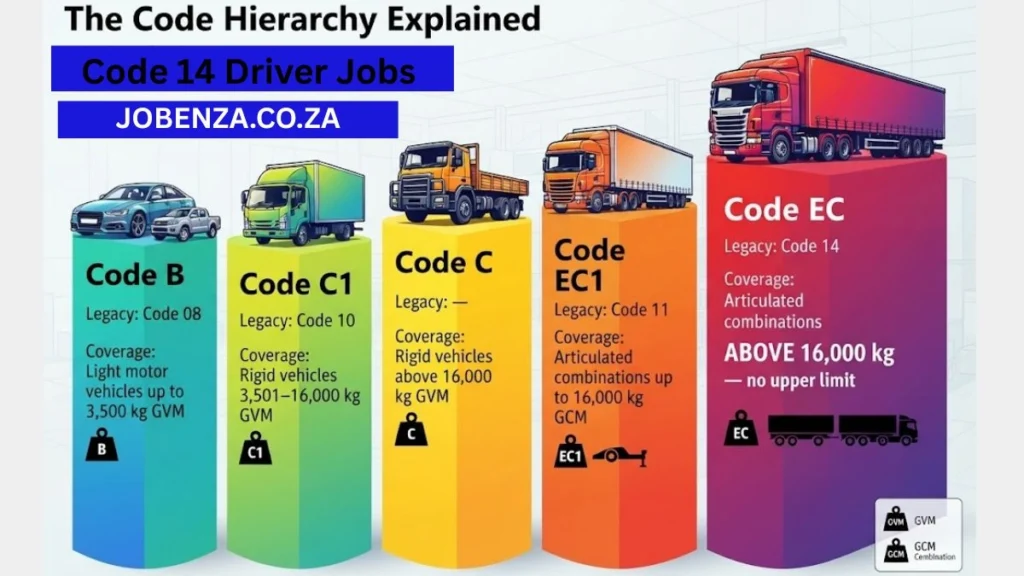
That final row is the whole point. A Code EC licence carries no maximum weight ceiling, which is why it unlocks superlinks, interlinks, fuel tankers, car carriers, low-beds, abnormal load rigs and side-tipper combinations. No other licence class gives you access to that equipment.
GVM versus GCM — Know the Difference
Recruiters use these terms constantly and applicants confuse them constantly:
- GVM (Gross Vehicle Mass) is the maximum permissible mass of a single vehicle, fully loaded.
- GCM (Gross Combination Mass) is the maximum permissible mass of the truck-tractor plus everything it tows, fully loaded.
A Code EC licence is defined by GCM because it is fundamentally a combination licence. When an advert says “Code 14 with superlink experience,” it is telling you the fleet runs combinations in the 50–56 tonne GCM range.
The Progression Path
You cannot walk in off the street and sit a Code EC test. South African law requires a stepped progression:
- Hold a valid Code B licence (the standard car licence)
- Obtain a Code C1 licence, which requires passing a heavy-vehicle learner’s test
- Apply for the Code 3 learner’s licence — the heavy-vehicle learner’s permit, valid for two years
- Complete practical training and pass the Code EC road test
Budget R9,000 to R18,000 for the full process in 2026, covering lesson packages (20–30 hours at R390–R500 per hour), test-day truck hire (R1,200–R2,500) and government fees of roughly R600–R750. Against a market where entry-level code 14 driver jobs start near R16,000 a month, that investment repays itself inside the first quarter of employment.
Section 3: Legal Compliance, Licence Validity and PrDP Requirements
Holding a Code EC card is necessary but not sufficient. To be paid to drive freight, you need a Professional Driving Permit (PrDP) — and this is where the majority of otherwise-qualified applicants get filtered out.
Understanding PrDP Categories
The PrDP license requirements break into three endorsement categories, each with its own scope and minimum age:
- PrDP G (Goods) — required for the commercial transport of goods. Minimum age 18. This is the baseline endorsement for virtually all code 14 driver jobs.
- PrDP P (Passengers) — required for vehicles carrying more than 12 passengers. Minimum age 21.
- PrDP D (Dangerous Goods) — required for hazardous cargo including fuel, chemicals and explosives. Minimum age 21, and it requires a separate Dangerous Goods training certificate.
A PrDP is valid for two years and must be renewed independently of your licence card. Your Code EC card itself carries a five-year validity. These two cycles do not align, which is the single most common compliance trap in the industry — drivers diarise their card renewal and let the permit lapse.
The Unendorsed Licence Rule
Employers regularly advertise for an “unendorsed licence” — meaning your record carries no disqualifying endorsements or suspensions. The two documents are legally separable: if you lose PrDP eligibility through a failed medical or a new conviction, your driving licence remains valid, but your PrDP is cancelled on eNaTIS and you cannot legally be paid to drive freight. Insurance underwriters and fleet compliance officers both check.
Code 14 Licence Renewal — Plan Ahead
Code 14 license renewal should begin at least four months before expiry. DLTC backlogs in Gauteng and the Western Cape are persistent, and driving on an expired card is an offence that terminates most employment contracts immediately. Renewal requires an eye test, the application form, proof of address and the card fee. Diarise the appointment the day you receive your new card — not the month it expires. Career resources on jobenza.co.za cover renewal timelines and provincial DLTC guidance.
Section 4: Medicals, Eye Tests and Criminal Clearance — The Vetting Gauntlet
Every serious logistics employer runs the same three-part screen. Failing any one of them ends the application, so prepare all three before you start applying.
Step 1: The MED 1 Medical Certificate
The MED 1 form must be completed and signed by a registered medical practitioner and must be no older than two months at the point of PrDP application. Expect to pay R350–R750. The examination covers:
- Cardiovascular assessment (blood pressure, cardiac history)
- Neurological screening — uncontrolled epilepsy is disqualifying
- Respiratory and sleep assessment — untreated sleep apnoea is a common and under-recognised rejection cause
- Diabetes and blood sugar management
- A review of chronic medications that impair alertness
Two practical notes: most conditions disqualify only when untreated or uncontrolled — well-managed hypertension or treated sleep apnoea can usually be certified — and booking with a practitioner who does occupational health regularly means the MED 1 is completed correctly first time, saving weeks.
Step 2: The Eye Test
Vision standards are stricter for heavy vehicles. You need adequate acuity in both eyes (correctable with glasses or contacts), a sufficient horizontal field of vision, and functional colour discrimination. If you wear corrective lenses this is coded onto your licence and you are legally required to wear them while driving — carry a spare pair in the cab, because roadside inspections check.
Step 3: SAPS Police Clearance
A South African Police Service clearance certificate, dated within the last six months, is mandatory. Standard processing runs 14–21 working days but can extend to six to twelve weeks in peak periods — apply early.
Certain convictions trigger automatic PrDP refusal, including driving under the influence, culpable homicide arising from a road incident, narcotics dealing and sexual offences. Older, minor convictions may be eligible for expungement under Section 271B of the Criminal Procedure Act, and that route is worth exploring with a legal advisor before assuming the door is closed.
The Full Document Pack
Assemble the following before your DLTC appointment:
- Completed PD1 application form
- Valid driving licence card
- South African ID or permanent residence permit
- Original MED 1 certificate (under two months old)
- Original SAPS clearance certificate (under six months old)
- Four passport photographs, 35 × 45 mm
- Proof of residential address under three months old
- Dangerous Goods training certificate, if applying for PrDP D
Section 5: What the Job Actually Involves Day to Day
Understanding the real work separates candidates who last from candidates who resign in month two. It also lets you answer interview questions with specifics rather than generalities.
Pre-Trip Inspection
Every shift starts with a documented walk-around, and it is a legal requirement, not a formality:
- Tyres — tread depth, sidewall damage, inflation across all axles including the spare
- Brakes — air build-up, leak-down test, service and park brake function, trailer response
- Coupling — fifth wheel jaw engagement, kingpin security, dog clip, susies and electricals
- Lights, reflectors and fluids — including trailer markers, oil, coolant, AdBlue, hydraulics
- Load security — straps, chains, tarpaulins, twist-locks, correct axle weight distribution
- Documentation — licence disc, roadworthy, manifest, delivery notes, and for hazardous cargo the correct placarding and tremcards
On the Road
Route planning is a genuine skill and a differentiator at interview. Competent heavy vehicle drivers plan around weighbridges, toll costs, height and mass restrictions, roadworks and secure rest stops. Fuel-efficient driving — progressive shifting, engine braking on descents, minimising idling — is measured by telematics on almost every fleet, and drivers with strong fuel scores get first pick of the best routes.
Fatigue Management
This is the defining challenge of long-distance driving jobs and the area where inexperienced drivers get into the most trouble. Practical discipline looks like:
- Taking a genuine break every four hours, out of the cab and moving
- Refusing to push through the 02:00–05:00 circadian low, which produces a disproportionate share of serious incidents
- Protecting bunk sleep quality with blackout curtains and consistent timing
- Managing hydration and avoiding heavy meals before a night stint
- Reporting fatigue honestly; reputable operators run a no-penalty stand-down policy, and the ones that do not are operators you should not work for
Security Awareness
Cargo hijacking is a real occupational risk on specific corridors. Standard protocol includes varying stop patterns, using only designated secure stops, keeping doors locked in urban congestion, staying silent on social media about routes and loads, and maintaining tracker and panic-button discipline. Interviewers will ask how you handle this — have an answer.
Section 6: Salaries, Allowances and Career Progression
What the Market Pays
The Code 14 salary in South Africa is underpinned by a statutory floor. The National Bargaining Council for the Road Freight and Logistics Industry (NBCRFLI) sets binding minimums by vehicle weight class:
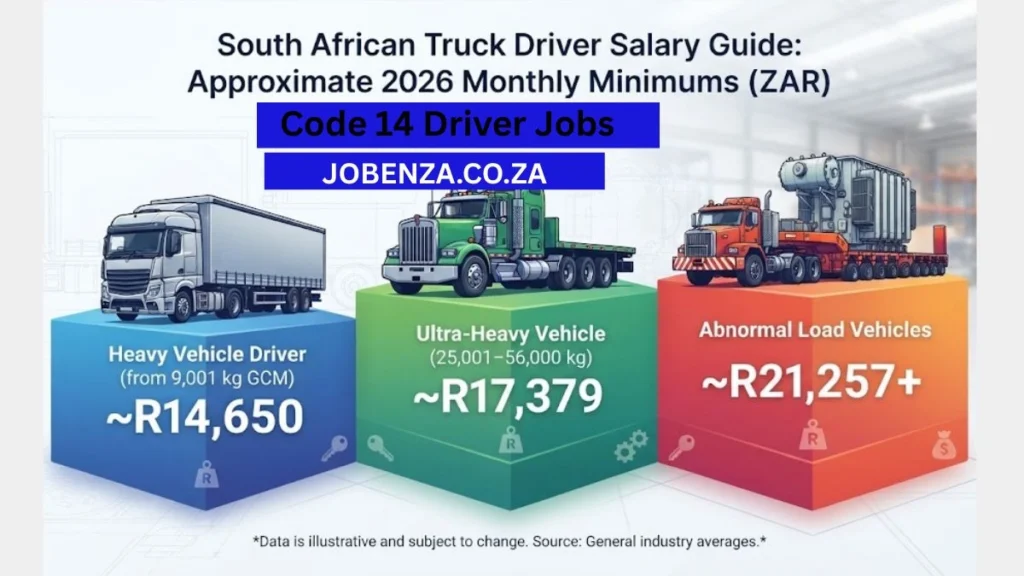
Market rates typically sit above those floors:
- Entry-level Code EC (0–2 years): R16,000 – R20,000
- Experienced local and line-haul: R20,000 – R25,000
- Cross-border on regular routes: R22,000 – R28,000
- Petroleum and chemical tanker (PrDP D): R25,000 – R30,000+
- Abnormal load specialists: R28,000 – R40,000+
Allowances Change the Picture Completely
Base salary understates real earnings. Subsistence allowances are where long-haul work pulls ahead:
- Domestic overnight subsistence: approximately R595 per day under the 2026/27 SARS-approved rate, tax-free within the prescribed limit
- Cross-border subsistence: R800 – R1,500 per day depending on route and operator
- Additional items: trip bonuses, fuel-efficiency incentives, safety and no-claim bonuses, border-crossing allowances, and standby pay
A driver running twenty overnight trips a month can add roughly R11,900 in largely tax-free allowances to their package. That is why comparing gross basic salaries alone is misleading, and why the employer requirements for heavy duty drivers on higher-paying routes are correspondingly stricter.
The Progression Ladder
Code 14 driver jobs are a starting point, not a ceiling. A realistic ten-year arc looks like this:
- Local rigid or shunting work — building clean-record hours
- Line-haul Code EC — the core earning years
- Specialised endorsement — tanker, abnormal load or cross-border, each adding a significant premium
- Driver trainer or assessor — training new intakes, usually with a road-safety qualification
- Fleet controller or dispatcher — planning routes, managing schedules, office-based
- Fleet supervisor or transport manager — full operational responsibility, frequently R40,000+ per month
The bridge between step three and step four is usually formal study: a Transport Management qualification, a National Certificate in Freight Handling, or a Road Transport Management System (RTMS) compliance credential. Drivers who add certification while still driving move up years faster than those who wait.
Section 7: How to Actually Land the Job
Build a CV That Survives the First Filter
Recruiters spend seconds on each application. Front-load the qualifying information:
- Header: name, contact number, city, and immediately — “Code EC (14) | PrDP G, valid to [month/year] | Unendorsed”
- Licence block: licence code, PrDP category and expiry, medical certificate date, PDP number
- Experience block: for each role state the vehicle configuration (superlink, interlink, tri-axle, tanker), the routes, the cargo type, and the years. “Drove trucks” tells a recruiter nothing. “Superlink, N3 Durban–City Deep container line-haul, 4 years, no at-fault incidents” tells them everything.
- Safety record: accident-free kilometres or years, fuel-efficiency scores, telematics ratings — these are your strongest differentiators
- Certifications: Dangerous Goods, forklift, first aid, defensive driving, load securement
- References: two contactable fleet supervisors, with permission secured in advance
Keep it to two pages. Attach clear scans of your licence, PrDP and ID — not blurry phone photos.
Pass the Practical Assessment
Nearly every reputable operator runs a yard and road assessment. Assessors score:
- A thorough, verbalised pre-trip inspection — narrate what you are checking and why
- Coupling and uncoupling performed calmly and correctly
- Reversing accuracy, including blind-side and dock alignment
- Gear and engine-brake discipline on gradients
- Mirror and blind-spot scanning frequency
- Following distance and general road courtesy
The single most common failure is rushing the pre-trip because you assume it is a formality. It is the part they watch most closely.
Search Efficiently
Applying to fifty scraped, out-of-date adverts is worse than applying to eight verified ones. Use a platform that validates its listings, filters by province and licence code, and lets you apply directly. jobenza.co.za exists for precisely this: verified South African truck driver vacancies, regional filtering, direct application, and career advisory content written for this market. Set up a profile, upload your document pack once, and apply in minutes rather than hours.
Interview Preparation
Expect scenario questions: a brake failure on a descent, a load-securement problem discovered 200 km out, a dispatcher pressuring you to drive while fatigued, a breakdown in a high-risk area. Answer with process, not bravado — safety-first reasoning is what gets you hired.
Section 8: Your Next Move Starts Today
South Africa’s freight economy is not slowing down. Port volumes are climbing, cross-border trade is deepening, and the pool of fully compliant, medically cleared, criminally vetted heavy vehicle drivers is not growing fast enough to keep pace. That imbalance is your leverage. Whether you are newly licensed, returning to the industry after a break, or an experienced line-haul operator ready to move into tanker or abnormal load work, the demand is there — and it rewards drivers who present themselves professionally.
Here is your action plan:
- Audit your documents this week. Licence card expiry, PrDP expiry, MED 1 date, SAPS clearance date. Renew anything within six months of lapsing.
- Rebuild your CV using the licence-forward structure above, with vehicle configurations and routes specified.
- Digitise your document pack — licence, PrDP, ID, certifications — as clear PDF scans.
- Register on jobenza.co.za, complete your profile, and set your province and licence-code filters.
- Apply consistently to verified listings rather than sporadically to scraped ones.
jobenza.co.za is built for South African job seekers who want verified opportunities rather than dead links. Active code 14 driver jobs are posted across Gauteng, KwaZulu-Natal, the Western Cape and the cross-border corridors, alongside practical career resources covering licensing, PrDP compliance and salary benchmarking. Browse current listings, filter to your region, and apply directly — no agency middlemen, no expired adverts.
Your licence is the hard part, and you have already done it. Go and get the job that matches it.
Visit jobenza.co.za today to browse verified code 14 and heavy vehicle listings, and fast-track your logistics career.