

If you’ve been searching for human resources jobs in South Africa, you already know the market has never been more dynamic — or more competitive. Between shifting labour laws, digital HR transformation, and a growing demand for skilled people-professionals, South Africa’s HR sector is quietly becoming one of the most rewarding career paths in the country. Whether you’re a fresh graduate chasing your first HR officer vacancies, an experienced practitioner eyeing HR manager careers, or a specialist pivoting into talent acquisition, this guide breaks down everything you need to know to land your next role with confidence.
Let’s get straight into it.
Why the HR Industry in South Africa Is Booming

South Africa’s business landscape has undergone a massive shift over the last few years, and Human Resources sits right at the centre of that change. Companies are no longer treating HR as a purely administrative function — it’s now a strategic pillar that touches everything from compliance to company culture.
A few forces are driving this growth:
- Digital transformation of HR functions — Cloud-based HRIS platforms, AI-assisted recruitment, and automated payroll systems mean HR professionals need tech fluency alongside people skills.
- Stricter enforcement of South African labour legislation — Businesses are investing heavily in compliance specialists to avoid costly disputes at the CCMA.
- The rise of hybrid and remote work — Organisations need HR teams who can manage distributed workforces, wellness programmes, and performance tracking across locations.
- Skills shortages in key sectors — Mining, banking, retail, and manufacturing are all competing for experienced HR generalists and specialists.
- Employee experience as a competitive advantage — Companies now realise that strong employee relations and culture-building directly affect retention and profitability.
All of this translates into consistent, real demand for qualified HR professionals across every experience level — from entry-level coordinators to senior executives shaping workforce strategy.
Types of Human Resources Jobs You Can Pursue

One of the best things about a career in HR is the sheer variety of paths available. You don’t have to pick one lane forever — many professionals move fluidly between generalist and specialist roles as their careers evolve.
HR Officer Vacancies
This is typically where many careers begin. HR officer vacancies usually involve handling day-to-day administrative and operational tasks: maintaining employee records, coordinating onboarding, managing leave and attendance systems, and supporting recruitment drives. It’s an excellent entry point because it exposes you to almost every corner of the HR function.
HR Generalist Roles
HR generalist roles are the backbone of most mid-sized organisations. Generalists wear multiple hats — recruitment, policy implementation, performance management, disciplinary processes, and training coordination. If you enjoy variety and don’t want to be boxed into one niche, this path offers excellent long-term flexibility and a strong foundation for future specialisation or management.
HR Manager Careers
For those with several years of experience, HR manager careers offer strategic influence and leadership responsibility. HR managers oversee entire HR departments, advise executives on workforce planning, manage budgets, and ensure the organisation stays compliant with ever-changing labour regulations. This role demands strong decision-making skills, commercial awareness, and the ability to manage people through change.
Specialist HR Roles
As the industry matures, specialisation is becoming increasingly valuable. Popular specialist tracks include:
- Talent acquisition specialists — focused purely on sourcing, interviewing, and securing top candidates for hard-to-fill roles.
- Employee relations officers — managing grievances, disciplinary hearings, union negotiations, and workplace conflict resolution.
- Learning and development (L&D) practitioners — designing training programmes and upskilling initiatives.
- Compensation and benefits analysts — structuring pay scales, incentive schemes, and employee benefit packages.
- HRIS and HR analytics specialists — using data to guide workforce decisions and improve retention.
Each of these niches typically commands a salary premium once you’ve built a track record, since specialized expertise is harder to replace.
Skills You Need to Succeed in Modern HR
Gone are the days when HR was simply about filing paperwork and organising leave forms. Today’s employers expect a blended skill set — part people-person, part strategist, part data analyst.
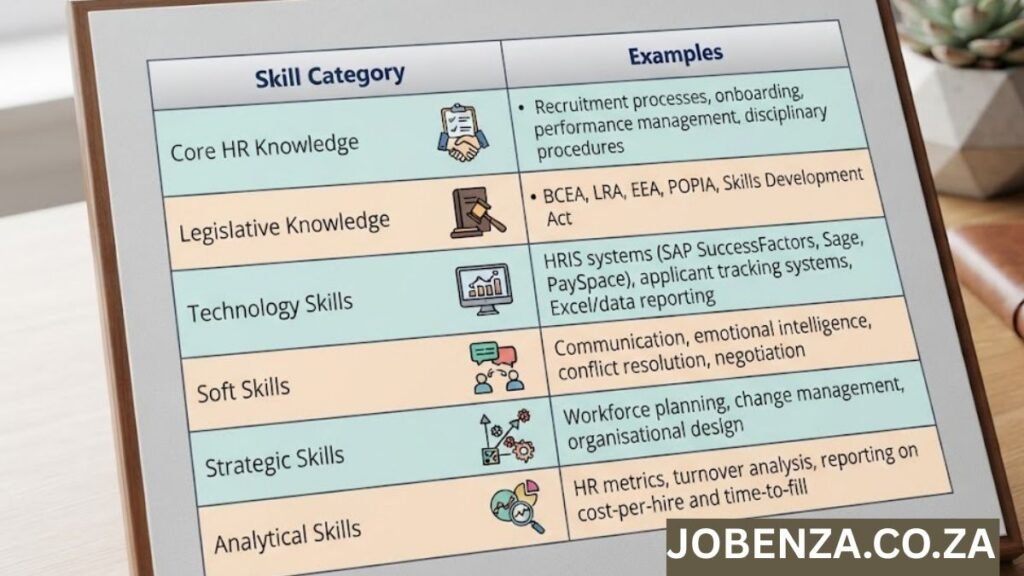
If you’re just starting out, focus on mastering the fundamentals — recruitment, onboarding, and basic labour law knowledge. As you progress toward HR manager careers, you’ll need to layer in strategic thinking, budgeting, and leadership capability.
Educational Qualifications and Certifications That Matter
While practical experience carries enormous weight in South Africa’s HR job market, formal qualifications still open doors — especially for graduate-level and management positions.
Common qualification pathways include:
- A National Diploma or Bachelor’s Degree in Human Resource Management, Industrial Psychology, or Labour Relations.
- An Honours or Postgraduate qualification for those aiming for senior HR manager or HR business partner roles.
- Professional registration with the South African Board for People Practices (SABPP), which is widely recognised as a mark of credibility in the industry.
- International certifications such as CIPD (Chartered Institute of Personnel and Development), which can strengthen your CV, particularly for multinational companies operating in South Africa.
- Short courses in payroll administration, labour law, or HRIS software, which are excellent for professionals looking to upskill quickly without committing to a full degree.
Employers increasingly value candidates who combine formal education with demonstrable, hands-on experience — so internships, vacation work, and volunteering with HR departments can be just as valuable as classroom learning.
Understanding South African Labour Legislation
You simply cannot succeed in this field without a solid grasp of South African labour legislation. Employers consistently rank legislative knowledge as one of the top hiring criteria, because non-compliance can expose a business to serious financial and reputational risk.
Key pieces of legislation every HR professional should understand include:
- Basic Conditions of Employment Act (BCEA) — governs working hours, leave entitlements, and termination procedures.
- Labour Relations Act (LRA) — covers unfair dismissal, collective bargaining, and dispute resolution through the CCMA.
- Employment Equity Act (EEA) — promotes fair representation and eliminates unfair discrimination in the workplace.
- Skills Development Act — encourages training and development through initiatives like SETAs and mandatory training levies.
- Protection of Personal Information Act (POPIA) — governs how employee data must be collected, stored, and protected.
If you want to stand out in interviews, be ready to discuss how you’ve applied — or would apply — these laws in real workplace scenarios. Employers love candidates who can translate legislation into practical, day-to-day decision-making.
Salary Expectations for HR Professionals in South Africa
Naturally, one of the biggest questions job seekers have is: what can I actually earn? While salaries vary depending on company size, industry, and location, here’s a general benchmark to help set realistic expectations.
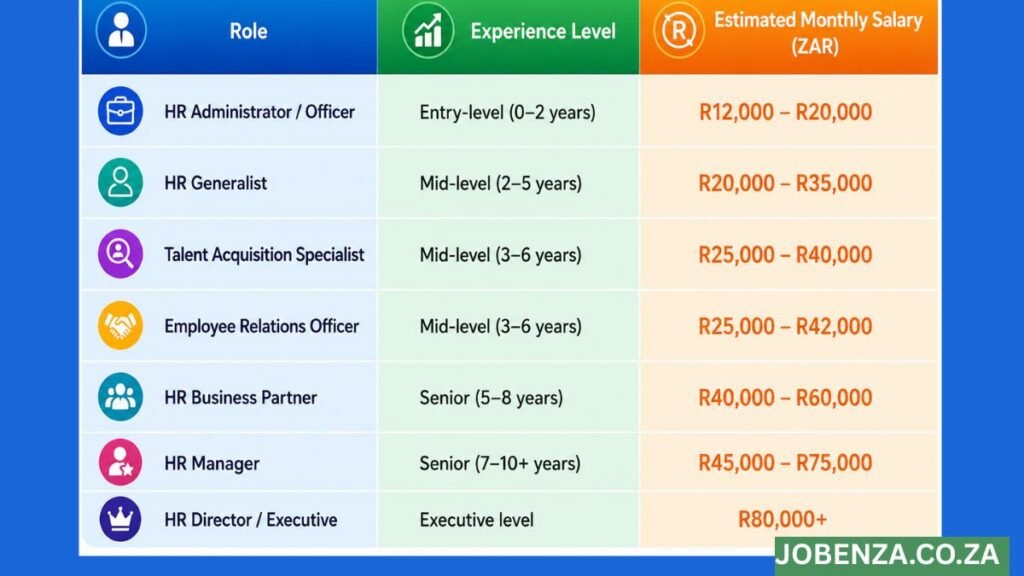
These figures are general estimates and can shift based on industry (financial services and mining tend to pay above average), company size, and geographic location. Johannesburg and Cape Town typically offer higher salary bands than smaller regional centres, though cost of living should always factor into your decision.
Where the Jobs Are: Industries and Cities Hiring HR Talent
HR talent is needed everywhere, but certain regions and sectors consistently show stronger hiring activity.
Top hiring cities:
- Johannesburg — South Africa’s economic hub, with strong demand across finance, mining, and corporate head offices.
- Cape Town — A growing tech and tourism sector fuels demand for modern, tech-savvy HR generalists.
- Durban — Manufacturing, logistics, and shipping industries drive steady HR hiring.
- Pretoria — Government departments and public sector entities frequently advertise HR officer and HR manager positions.
Top hiring industries:
- Banking and financial services
- Retail and FMCG
- Mining and resources
- Manufacturing and logistics
- Healthcare
- Information technology and telecommunications
- Public sector and government departments
If you’re flexible about industry, you’ll significantly widen your pool of opportunities — many core HR skills transfer seamlessly across sectors.
How to Land Your Next Human Resources Job: Actionable Tips
Knowing the market is one thing — actually breaking into it is another. Here’s how to give yourself a genuine edge.
Craft a CV That Gets Noticed
Most companies now use Applicant Tracking Systems (ATS) to filter CVs before a human ever sees them. To beat the bots:
- Use clear, standard headings (Experience, Education, Skills).
- Include keywords relevant to the role, such as “recruitment,” “onboarding,” “employee relations,” or “payroll administration.”
- Quantify your achievements — for example, “Reduced average time-to-hire by 20%” rather than vague statements.
- Keep formatting simple; avoid tables, graphics, or columns that ATS software struggles to read.
Build a Strong Professional Network
HR is a relationship-driven profession, and many roles are filled through referrals before they’re even publicly advertised. Attend industry webinars, join HR associations, and stay active on professional networking platforms. Engaging thoughtfully with HR-related content can also put you on recruiters’ radars organically.
Prepare Thoroughly for Interviews
HR interviews often test both your technical knowledge and your interpersonal judgment. Be ready for:
- Scenario-based questions (“How would you handle a disciplinary hearing where the employee disputes the evidence?”)
- Legislative knowledge checks (“Walk me through the CCMA dispute process.”)
- Behavioural questions using the STAR method (Situation, Task, Action, Result)
- Questions about your approach to confidentiality and ethics, given the sensitive nature of HR data
A great tip: prepare two or three real examples from your experience (or coursework/internships if you’re early-career) that demonstrate problem-solving, discretion, and fairness — these come up in almost every HR interview.
Keep Upskilling
The HR field evolves quickly. Dedicate time each quarter to learning something new — whether that’s a short course on HR analytics, an update on recent labour law amendments, or familiarising yourself with a new HRIS platform. Continuous learning signals to employers that you’re serious about long-term growth in the profession.
Common Pain Points Job Seekers Face — and How to Solve Them
Let’s be honest: job hunting in HR isn’t always smooth sailing. Here are the most common frustrations candidates report, along with practical fixes.
“I keep getting rejected without feedback.”
This is incredibly common and rarely personal. Focus your energy on tailoring each application rather than mass-applying with a generic CV — quality beats quantity almost every time.
“I don’t have enough experience for the roles I want.”
Consider entry points like HR internships, temp administrative roles, or volunteering with HR departments in NGOs. These experiences count and can be leveraged into your first proper HR officer role.
“I don’t know which jobs are actually legitimate.”
Unfortunately, fake job postings and scams do circulate online. Always verify company details, avoid postings that ask for upfront payments, and stick to reputable job platforms with verified listings.
“I apply everywhere but hear nothing back.”
This usually points to either CV formatting issues (ATS rejection) or applying to roles that don’t match your experience level. Refining your CV and being strategic about which roles you target can dramatically improve your response rate.
Your Ultimate Career Partner: Find Human Resources Jobs on Jobenza.co.za
Here’s the truth: even with a polished CV and strong interview skills, your job search will only go as far as the platform you’re using to find opportunities. This is exactly where jobenza.co.za comes in.
Jobenza.co.za is designed to be your one-stop destination for discovering human resources jobs across South Africa — from entry-level HR officer vacancies to senior HR manager careers and everything in between. Instead of scrolling through outdated listings on generic job boards, Jobenza gives you access to consistently updated, relevant opportunities tailored to the South African employment landscape.
Here’s what makes it worth adding to your job-search toolkit:
- Live, regularly updated listings — Browse current HR generalist roles, talent acquisition positions, and employee relations vacancies without wading through expired ads.
- Simple CV submission — Upload your CV directly on the platform so recruiters and hiring companies can find you when a matching role opens up.
- Career-focused resources — Stay informed about hiring trends, in-demand skills, and evolving South African labour legislation that affects the HR profession.
- User-friendly search and filtering — Narrow down opportunities by location, industry, or experience level so you spend less time searching and more time applying.
Whether you’re taking your very first step into the HR profession or you’re an experienced practitioner ready for your next big move, visiting jobenza.co.za and submitting your CV is one of the smartest moves you can make this year. Set aside ten minutes today to create your profile, upload your CV, and start exploring live listings — your next opportunity might already be waiting there.
Final Thoughts: Your HR Career Starts With the Right Move
South Africa’s HR industry is growing, evolving, and rewarding those who stay informed, skilled, and proactive. Whether your goal is landing your first HR officer vacancies, transitioning into specialised talent acquisition work, mastering employee relations, or eventually stepping into senior HR manager careers, the opportunities are absolutely there for the taking.
The key is combining solid legislative knowledge, continuously sharpened soft and technical skills, and a smart, targeted job-search strategy. Pair that with a reliable platform like jobenza.co.za to connect you with real, live opportunities, and you’ll be well-positioned to build a fulfilling, long-term career in Human Resources.
Your next role in HR isn’t a matter of luck — it’s a matter of preparation, persistence, and knowing exactly where to look. Start today.