


Millwright jobs in South Africa are currently among the most secure, best-paid, and most aggressively recruited artisan positions in the entire labour market. Every automated bottling line, every conveyor system, every packaging machine, and every mine winder depends on a qualified millwright to keep production moving.
If you already hold a Red Seal — or you are working toward one — you own a skill set that employers are actively competing to secure.
The numbers explain the urgency. South Africa’s National Development Plan set a target of 30,000 newly qualified artisans every year by 2030, and the country has fallen consistently short of that figure.
That shortfall is not theoretical. It shows up as unplanned downtime, missed production targets, and maintenance teams running short-handed on night shift.
This guide breaks down exactly where the work is, what it pays, which certifications actually move the needle, and how to convert applications into interviews.
Why the Millwright Trade Has Become South Africa’s Most Valuable Artisan Ticket

The Dual-Trade Advantage
A millwright is not a fitter who picked up some wiring knowledge, nor an electrician who can swap a bearing. The trade is formally dual-disciplined, covering both mechanical and electrical scopes under a single trade certificate.
That combination is precisely why maintenance managers fight to retain millwrights. One artisan can isolate a machine, diagnose a tripped overload, replace a failed contactor, realign a coupling, and hand the line back to production — without waiting on a second trade to arrive.
Core competency areas across almost all millwright jobs in South Africa include:
- Mechanical work: bearing replacement, gearbox overhauls, laser shaft alignment, chain and belt drives, pumps, compressors, conveyor systems, and basic fabrication.
- Electrical work: three-phase 400V reticulation, motor control centres (MCCs), direct-on-line and star-delta starters, contactors, overload protection, cable termination, and live-circuit fault finding.
- Hydraulics: power packs, directional control valves, actuators, accumulators, seal kits, and contamination control.
- Pneumatics: FRL units, solenoid valve banks, cylinders, and air-preparation systems.
- Instrumentation: proximity and photoelectric sensors, rotary encoders, load cells, and 4–20 mA transmitter loops.
How Automation Rewrote the Job Description
A decade ago, a millwright who could strip a gearbox and megger a motor was employable almost anywhere. Today that is the baseline, not the differentiator.
Modern South African plants run Siemens S7 and TIA Portal, Allen-Bradley ControlLogix and Studio 5000, plus Mitsubishi and Omron platforms. The artisan who can go online with a PLC, interrogate the fault logic, and determine whether the failure is a sensor, a drive parameter, or a network fault is worth dramatically more than one who cannot.
Add variable speed drive (VSD) configuration, HMI navigation, and industrial networking fundamentals — Profibus, Profinet, EtherNet/IP, Modbus, and AS-i — and you move straight into the upper salary band.
Reliability tooling matters too. Familiarity with vibration analysis, thermography, condition monitoring, and CMMS platforms such as SAP PM, On Key, or Maximo signals that you think in terms of MTBF and MTTR, not just breakdown callouts.
The Shift-Work Reality Nobody Explains Upfront
Most millwright jobs in South Africa are shift-based, because plants that stop running cost money every minute. Expect eight-hour rotating cycles across day, afternoon, and night, or twelve-hour 4-on-4-off rosters in continuous-process operations.
Standby weeks are standard. You carry the callout phone, you stay within reach of the plant, and you earn a standby allowance for the disruption.
Planned shutdowns are where the serious money lives. Annual and biannual shutdowns concentrate overtime at 1.5x and 2x rates under the Basic Conditions of Employment Act, and many artisans bank a significant slice of annual earnings inside those windows.
Where the Work Is: Industrial Hubs Driving Millwright Jobs in South Africa
Geography determines both your salary and your sector. Knowing which corridor suits your skill set is the fastest way to stop wasting applications.
Gauteng: Why Millwright Jobs in Gauteng Dominate the Market
Gauteng holds the densest concentration of manufacturing plants in the country, which is why millwright jobs in Gauteng consistently outnumber every other province on the major boards.
The East Rand corridor is the historic engine room. Germiston, Wadeville, Alrode, Isando, Jet Park, Spartan, Boksburg, Benoni, and Nigel host steel processing, packaging, plastics, chemicals, and automotive component manufacturing at scale.
Johannesburg south and west add further depth. City Deep, Denver, Aeroton, Village Deep, Chamdor, and Randfontein carry food production, printing, cold chain, and warehousing automation.
Tshwane brings the automotive giants. Rosslyn and Silverton anchor vehicle assembly and their Tier 1 supplier networks, while Pretoria West and Babelegi handle heavier fabrication and processing.
The Vaal Triangle completes the picture. Vanderbijlpark, Vereeniging, and the adjacent Sasolburg petrochemical belt carry steel, chemicals, and heavy industry roles that reward artisans comfortable with large rotating equipment.
Practical takeaway: if you are chasing millwright jobs in Gauteng, filter your searches by suburb rather than by city. Recruiters advertise “Alrode” or “Isando” far more often than they advertise “Johannesburg”.
Competition is also higher here, so response speed matters more. The best millwright jobs in Gauteng are frequently filled from applications received before the advert has been live a full week.
Mpumalanga and Limpopo: Coal, Power, and Platinum
The eMalahleni, Middelburg, and Secunda triangle carries coal mining, power generation, and petrochemical processing. Roles here typically pay above the national average, but demand mining-specific compliance.
Limpopo’s platinum belt around Steelpoort, Burgersfort, and Mokopane offers similar packages. Concentrator plants, crushing circuits, and materials handling systems form the bulk of the maintenance scope.
KwaZulu-Natal, Western Cape, and Eastern Cape
KwaZulu-Natal’s industrial spine runs through Pinetown, New Germany, Mobeni, Jacobs, Prospecton, Hammarsdale, and Cato Ridge, with Richards Bay adding aluminium smelting, heavy minerals, and pulp production.
The Western Cape concentrates in Epping, Parow Industria, Blackheath, Killarney Gardens, Montague Gardens, and Atlantis. Food and beverage, wine processing, cold chain, and pharmaceutical manufacturing dominate the vacancy mix.
The Eastern Cape is automotive-led. Kariega, Struandale, Markman, the Coega SEZ, and East London’s IDZ support vehicle assembly plants and their component supply chains.
The Sectors That Recruit Hardest
- FMCG and food and beverage: high-speed filling, capping, labelling, and palletising equipment — the largest single employer of millwrights nationally.
- Mining and minerals processing: crushers, mills, conveyors, thickeners, and pumps.
- Automotive manufacturing: robotics, press shops, paint lines, and assembly conveyors.
- Packaging and paper: corrugators, converting lines, glass forming, and injection moulding.
- Petrochemical and heavy industry: rotating equipment, compressors, and process plant.
- Renewables and utilities: wind farm maintenance, solar PV plants, and water treatment works.
Best Practices for Using Digital Job Portals and Millwright Jobs Pnet Searches

Most artisans lose opportunities not because they lack skill, but because they use job boards passively. The fix is mechanical and repeatable.
Aggregators such as Pnet, CareerJunction, Indeed ZA, and SimplyHired carry the bulk of advertised millwright jobs in South Africa, and each rewards a slightly different search technique. Learn the mechanics once and the same routine works everywhere.
Build a Profile That Recruiters Can Actually Find
Recruiters do not only wait for applications — they search CV databases using keyword strings. If your profile does not contain the words they type, you are invisible regardless of how strong your experience is.
When people search for millwright jobs Pnet listings, they usually stop at the search results page. The higher-value move is to complete your profile until it is fully searchable, then let recruiters find you while you sleep.
Your profile should explicitly include:
- Your trade certificate designation and the year you passed your trade test.
- Every PLC, VSD, and SCADA platform you have worked on, spelled out by brand and model.
- The specific OEM machinery you have maintained, named directly.
- Your licences and appointments: driver’s code, forklift, overhead crane, working at heights, first aid, and any legal appointments held.
- Your notice period and whether you are open to relocation or shutdown contracts.
Set Up Alerts Instead of Refreshing Pages
Artisan vacancies move fast. Many maintenance roles are filled from applications received in the first 48 to 72 hours, because managers need the position covered on the next shift roster.
Create multiple saved alerts rather than one broad one. A single alert for “millwright” is too noisy; separate alerts for “millwright Gauteng”, “millwright FMCG”, and “millwright shutdown contract” deliver cleaner results.
Artisans who rely only on a one-off millwright jobs Pnet search consistently arrive late. Alerts flip the process around, pushing new vacancies to you the moment they publish.
Set alerts to daily rather than weekly. On a weekly cycle you will routinely arrive after the shortlist has already closed.
Search With Variations, Not Just One Term
Job titles are inconsistent across South African employers. The same role may be posted as Millwright, Maintenance Millwright, Multi-Skilled Artisan, Electro-Mechanician, Maintenance Artisan, or Automation Technician.
Search every variant. Artisans who search only one exact title routinely miss 30–40% of the live market.
Maximizing Online Search Efficiency: Tracking Pnet Millwright Jobs and Beyond
Volume alone does not win interviews. Structure does.
The artisans who move fastest treat their shortlist of Pnet millwright jobs and equivalent listings as a live pipeline, not a wish list. Every advert gets screened, filtered, and either actioned or discarded the same day.
Filter Ruthlessly, Then Apply Selectively
When reviewing Pnet millwright jobs or listings on any comparable aggregator, apply filters in this order: location radius first, then contract type, then salary band, then date posted.
Sorting by date posted is the single highest-impact habit. Applying to a two-week-old advert usually means competing against a shortlist that already exists.
Read the full advert before applying. Adverts that specify a sector, a PLC platform, or a particular machine type are telling you exactly which keywords must appear in your CV.
Tailor Every Application in Under Ten Minutes
You do not need a new CV for each role. You need a controlled top section that you adjust in minutes.
Keep a master CV, then edit only your professional summary and your first three bullet points to mirror the advert’s language. If the advert emphasises Siemens and packaging equipment, those words must appear in your opening lines.
Track Everything in a Simple Spreadsheet
Serious job seekers treat the search like a maintenance schedule. Log the company, the role, the date applied, the source, the contact person, and the follow-up date.
Follow up five to seven working days after applying. A short, professional email that restates your trade certificate and availability is often enough to move your CV to the top of the pile.
A tracked spreadsheet also stops you re-applying to the same advert. Pnet millwright jobs and other aggregator listings are frequently reposted by multiple agencies, and duplicate applications through different recruiters can quietly damage your credibility with the end client.
Most importantly, keep the pipeline full. Working artisans who chase one opportunity at a time stay in weak negotiating positions; those running 10 to 15 live applications negotiate from strength.
Essential Qualifications and Certifications to Get Hired
The Red Seal Trade Certificate
The Red Seal is the non-negotiable credential. Issued through the National Artisan Moderating Body (NAMB), it certifies you as a qualified artisan nationally and is recognised across every sector.
Most trade tests are written at INDLELA in Olifantsfontein or at NAMB-accredited private trade test centres. The test is practical, timed, and unforgiving — candidates who fail typically do so on fault-finding sections rather than hand skills.
There are two main routes to the test. The apprenticeship or learnership route runs through a SETA, most commonly merSETA for manufacturing and engineering, or the MQA for mining.
The second route is recognition of prior learning under Section 26D of the Skills Development Act. This allows experienced workers with verifiable years of relevant plant work to challenge the trade test directly — a critical pathway for artisans who trained informally on the job.
N-Courses and Formal Theory
Theory requirements are usually N2 or N3 minimum for trade test entry, covering Engineering Science, Mathematics, and trade theory.
Progressing to N4–N6 unlocks the National N Diploma once you complete the required practical experience. That diploma matters if you intend to move into planning, supervision, or a technician role later.
Automation and PLC Skills
This is the fastest available salary increase in the trade. Short courses in Siemens TIA Portal or Allen-Bradley Studio 5000 typically cost a fraction of a month’s salary and reposition you as an automation-capable artisan.
Prioritise, in order: PLC fault finding and online diagnostics, VSD parameter setting, HMI and SCADA navigation, and industrial network troubleshooting.
Safety and Legal Compliance
Compliance credentials are often the deciding factor between two equally skilled candidates. A large share of advertised millwright jobs in South Africa now list safety documentation as a screening requirement rather than a preference.
- OHS Act 85 of 1993 awareness, including hazard identification and risk assessment.
- Lockout/tagout (LOTO) and permit-to-work discipline.
- GMR 2.1 appointments where applicable, which carry real legal weight and real salary premium.
- Mine Health and Safety Act induction and a valid Certificate of Fitness for any mining role.
- Working at heights, confined space entry, and first aid certification.
Building a Technical CV That Survives the Screen
Generic CVs get discarded. Technical CVs get shortlisted.
Lead with a plant and equipment inventory — name the actual machines, brands, and control platforms you have maintained. A hiring manager scanning for “Krones” or “ControlLogix” will find you instantly.
Quantify outcomes wherever possible. “Reduced filler downtime by 18% over six months through a revised lubrication schedule” outperforms “responsible for maintenance” every single time.
Keep it to two or three pages and attach certified copies of your trade certificate, N-certificates, and identity document. Missing documentation is the most common reason applications stall.
Find Verified Artisan and Engineering Vacancies on Jobenza
Searching across five different platforms every morning is exhausting, and it is the main reason strong artisans give up on the search too early.
Jobenza.co.za was built to solve exactly this problem for South African job seekers. The platform brings verified technical and engineering vacancies into one place, so you spend your time applying rather than hunting.
Here is how to use it properly:
- Browse the live technical listings and filter by province, city, and industrial hub to surface roles that are genuinely commutable.
- Set up real-time career alerts for millwright, artisan, and maintenance roles so new postings reach you the same day they go live.
- Search by sector, not just job title, to uncover FMCG, mining, packaging, and automotive vacancies you would otherwise scroll past.
- Apply directly through the platform, keeping every application in one trackable place instead of scattered across inboxes.
- Bookmark jobenza.co.za and check it as part of your daily routine — consistency beats intensity in an artisan job search.
The engineering and artisan section is updated continuously, and new vacancies across Gauteng, KwaZulu-Natal, the Western Cape, Mpumalanga, and Limpopo appear regularly.
Make jobenza.co.za your home base for the search. Set your alerts once, check the board daily, and let the opportunities come to you.
Salary Expectations for Millwrights in South Africa
Pay varies widely by sector, province, and automation capability. The ranges below reflect typical market conditions and should be checked against live listings before you negotiate.
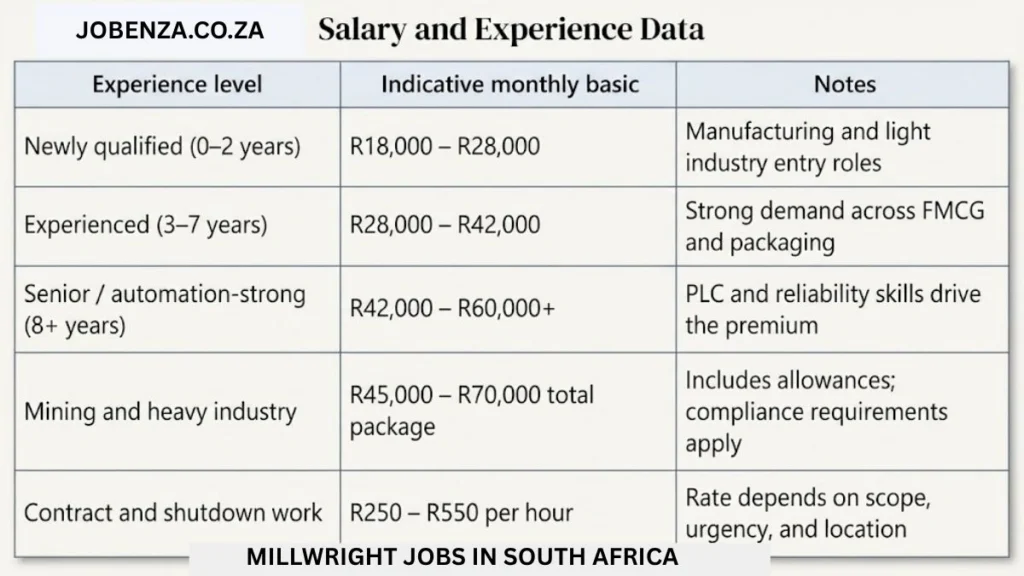
Remember that basic salary is only part of the picture. Shift allowances, standby allowances, overtime, provident fund contributions, and medical aid subsidies frequently add 20–35% to total earnings.
Contract work pays a higher headline rate but carries no benefits and no guaranteed continuity. Permanent roles pay less per hour but deliver stability, training investment, and clear internal progression.
Conclusion: The Career Outlook for South African Artisans
The demand picture for qualified artisans remains structurally strong. Ageing industrial infrastructure, rapid plant automation, and a persistent shortage of trade-tested professionals all point in the same direction.
Millwright jobs in South Africa will continue to reward artisans who invest in automation literacy, maintain clean compliance records, and present their experience in technical, quantified language.
Your action plan is straightforward. Secure or maintain your Red Seal, add PLC and VSD capability, rebuild your CV around named equipment and measurable results, set daily alerts across the major boards, and apply within the first 72 hours of a posting going live.
Then keep going. The artisans who land the best roles are rarely the most gifted on the tools — they are the ones who stayed organised, applied early, and never let the pipeline run dry.
Start browsing live artisan and engineering vacancies on jobenza.co.za today, set your alerts, and take the next step in your maintenance career.
Frequently Asked Questions
How long does it take to qualify as a millwright in South Africa? A standard apprenticeship typically runs three to four years, including theory, workplace experience, and the trade test. Candidates using the Section 26D recognition of prior learning route may qualify faster if they already have substantial verifiable plant experience.
Is a millwright qualification better than a fitter or electrician qualification? For employability, yes — the dual scope means you qualify for a wider range of vacancies and command a salary premium. However, specialists in high-demand niches such as instrumentation or industrial electronics can earn comparably.
Which province has the most millwright vacancies? Gauteng consistently leads on volume because of its manufacturing density. Mpumalanga, Limpopo, and the North West frequently offer higher total packages due to mining allowances.
Do I need PLC skills to get hired? Not strictly, but they materially improve your prospects. Automation-capable artisans access the senior salary bands significantly faster than those limited to mechanical and basic electrical work.
Can I work abroad with a South African Red Seal? Many artisans do, particularly across the Gulf states, Australia, Canada, and sub-Saharan mining operations. Most destinations require a skills assessment or a recognition process, so verify the requirements with the relevant authority before committing to a move.
Should I take contract work or hold out for a permanent role? Shutdown and project contracts pay well and build valuable plant exposure quickly. If you are early in your career or between roles, contract work is a strong bridge — just keep applying for permanent positions while you are on site.
What is the fastest way to get noticed by recruiters? Complete your online profile with searchable technical keywords, apply within the first 72 hours of a posting, and follow up in writing after five to seven working days. Those three habits alone outperform almost any other tactic.