
Cape Town’s skyline, harbour, and industrial belt are quietly running on one trade that never goes out of demand: welding. Between the Port of Cape Town’s ship repair yards, the Saldanha Bay energy corridor, and a construction sector that hasn’t slowed down since load-shedding eased, welding jobs in Cape Town are among the most consistently advertised skilled-trade roles in the Western Cape. Yet most articles ranking for this topic just list job boards and stop there — they don’t explain what a Cape Town shipyard actually checks before hiring you, what a Transnet port clearance involves, or how salaries here really compare to Gauteng and Durban.
This guide fills those gaps. It’s written for artisans, apprentices, and career-changers who want more than a list of vacancies — you’ll get the certification pathway, the real industries hiring, honest salary numbers, and the local networking tactics that actually get interviews booked. And if you’re ready to start applying, Jobenza.co.za keeps a live, verified feed of welding jobs across the Western Cape so you’re not wasting time on expired listings.
Why Cape Town Needs Skilled Welders Right Now
Three forces are driving demand simultaneously. First, the Port of Cape Town and Saldanha Bay handle a steady flow of vessel maintenance, meaning ship repair yards need coded plate and pipe welders year-round. Second, the Western Cape’s construction pipeline — from mixed-use developments in the CBD to industrial expansion in Atlantis and Paarden Eiland — keeps structural steel fabricators busy. Third, an ageing coded-welder workforce nationally means companies are actively recruiting and, in many cases, training new apprentices to close the skills gap.
If you’re weighing your options nationally, it’s worth knowing how Cape Town stacks up: welding jobs in gauteng lean heavily on heavy manufacturing, mining equipment, and automotive plants around Johannesburg and Pretoria; welding jobs in durban are dominated by shipbuilding, sugar mill fabrication, and the Richards Bay aluminium and metals corridor. Cape Town sits in between — a mix of maritime, construction, and light industrial work with a growing renewable-energy angle. Across welding jobs in south africa generally, coded welders with process-specific tickets are the ones getting first calls.
Technical Requirements & Certifications: What Employers Actually Check
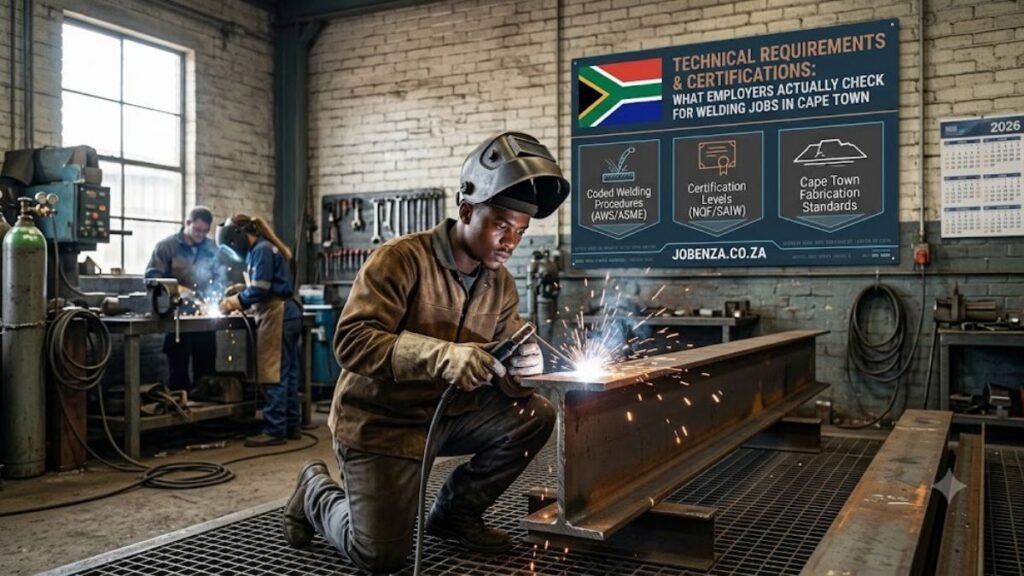
This is the section most guides skip past. Cape Town employers — especially anyone hiring for harbour or oil & gas work — are far stricter about paperwork than general classifieds suggest.
1. Trade Qualification (the foundation)
You need a recognised trade test, typically through a merSETA-accredited institution or TVET college, resulting in your Red Seal certificate as a qualified welder. Without this, you’re limited to assistant or trainee roles regardless of practical skill.
2. Process-Specific Coding
A trade certificate alone doesn’t get you onto a fabrication floor. Employers want process-specific coding — proof you can weld to a qualified procedure in a specific process and position. This is where TIG/MIG welding jobs become relevant: TIG (GTAW) coding is essential for stainless steel, aluminium, and pipe work common in food-grade and marine fabrication, while MIG (GMAW) coding covers structural steel and general fabrication. Many Cape Town roles also require Stick (MMAW) coding for site and repair work where portability matters more than speed.
3. SAIW and IIW Certification
The South African Institute of Welding (SAIW) is the country’s IIW Authorised Nominated Body, meaning its certifications carry international recognition. Coded welder status through SAIW-aligned Welder Performance Qualification (WPQ) testing is the single most requested credential in job ads for this region. If you’re aiming higher — supervisor, inspector, or engineer — SAIW’s Welding Inspector and International Welding Engineer (IWE) programmes are the recognised route, and SAIW also runs sessions closer to Cape Town rather than only its Johannesburg campus, so check current regional course dates.
4. Position and Thickness Qualifications
Pipe welders are qualified by position (1G through 6G) and thickness range. Plate welders are qualified similarly (1F to 4F). Shipyards and pressure-vessel fabricators will ask specifically which positions and thickness ranges your WPQ covers — this single detail often determines whether you’re shortlisted for pipe work, which typically pays more than plate.
5. Non-Destructive Testing (NDT) Awareness
You don’t need to be an NDT technician, but understanding how your welds will be tested — visual inspection, dye penetrant, radiographic, or ultrasonic testing — signals professionalism. Fabrication shops supplying the oil & gas sector in Saldanha Bay routinely reject welders who can’t explain basic NDT acceptance criteria.
6. Safety and Site-Access Certifications
This is the biggest local gap in existing guides: harbour and port-adjacent employers require a Transnet or port authority security clearance before you can even step onto ship repair premises. Add to that working-at-heights certification, confined space entry training, and a valid medical fitness certificate, and you have the standard “ready to start” file that Cape Town shipyards expect on day one — not after hiring.
7. Apprenticeship Route
If you’re starting from zero, welding apprenticeships through merSETA, TVET colleges, or direct company intake programmes remain the most reliable entry path. Look specifically for programmes with an indentured agreement, since these guarantee structured trade-test preparation rather than informal on-the-job training alone.
Top Industries Hiring: Where Cape Town’s Welding Jobs Actually Are
Shipyards and Maritime Repair
The Sturrock Dry Dock and surrounding ship repair facilities at the Port of Cape Town are the region’s largest concentrated source of coded welding work. These yards need plate and pipe welders comfortable in confined vessel spaces, often on rotating shifts to meet vessel turnaround deadlines. Boat-building manufacturers around Paarden Eiland and the Waterfront precinct — building catamarans and pleasure craft for export — add a steady stream of aluminium TIG welding roles, which pay a premium over standard structural work due to the skill ceiling involved.
Construction Welding
Construction welding jobs Cape Town cover structural steel erection, rebar fabrication, and site welding for commercial and residential developments. This sector is less specialised than maritime work but offers high job volume, especially during infrastructure and housing pushes in the northern suburbs and CBD densification projects. Site welders here benefit from also holding a valid driver’s licence and their own basic tool kit, which recruiters flag repeatedly as a differentiator.
Oil, Gas, and Energy
Saldanha Bay’s Industrial Development Zone services offshore rig maintenance and energy infrastructure projects, creating demand for pipe welders with pressure-vessel experience. This sector pays the strongest premiums in the Western Cape but also has the strictest documentation requirements — expect background checks, drug testing, and full NDT-linked WPQ verification before an offer is made. Renewable energy is a growing sub-sector too, with wind turbine tower and component fabrication increasingly outsourced to Western Cape metal fabricators.
Manufacturing and General Fabrication
Industrial hubs in Atlantis, Epping, and Bellville host general fabrication shops producing everything from agricultural equipment to retail shopfitting steelwork. These roles are more accessible for newly coded welders and often serve as a stepping stone toward maritime or oil & gas positions once you’ve built up verified experience.
How Cape Town Compares Regionally
If relocation is on the table, it helps to see the national picture. Welding jobs in gauteng concentrate around Johannesburg’s mining equipment manufacturers, automotive assembly plants, and heavy structural steel fabricators — higher volume, but more competition. Welding jobs in durban centre on shipbuilding at the harbour, sugar mill and refinery maintenance, and the aluminium smelting corridor near Richards Bay. Cape Town’s advantage is variety: you can move between maritime, construction, and energy work without relocating, which is harder to do in single-industry hubs elsewhere.
Salary Expectations & Career Growth
Numbers vary by employer, contract type, and whether you’re plate or pipe coded, but here’s a realistic 2026 benchmark for certified welder salary South Africa figures, adjusted for the Western Cape market:
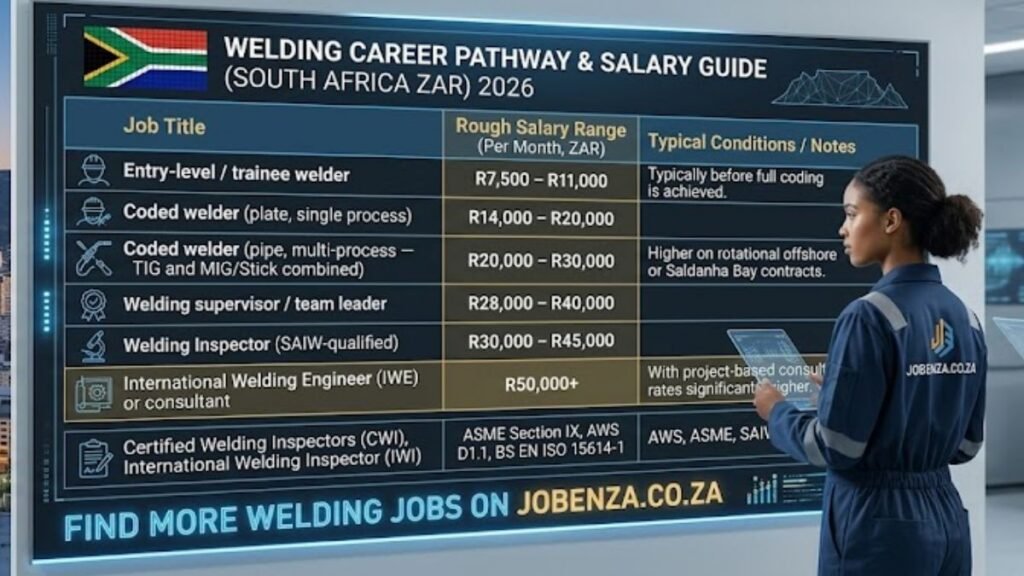
Contract and rotational offshore positions often pay a day rate rather than a monthly salary, and these rates can outstrip permanent equivalents substantially — but expect less job security and gaps between contracts. Compared nationally, Gauteng’s high job volume can mean faster entry-level placement, while Durban’s shipbuilding sector often matches Cape Town’s maritime pay bands closely. Cape Town’s oil & gas-linked roles tend to sit at the top of the national range due to Saldanha Bay’s specialised pressure-vessel work.
Career growth in this trade is refreshingly linear if you invest in certification: apprentice, coded welder, senior/specialist welder, supervisor, welding inspector, and finally welding engineer or independent consultant. Each step typically requires a specific SAIW or equivalent qualification rather than just years of experience, which means deliberate upskilling moves you up faster than time alone.
Expert Tips for Landing Interviews in Cape Town
Most advice online stops at “update your CV.” Here’s what actually moves the needle locally.
- Get your Transnet/port clearance sorted before applying, not after. Ship repair employers frequently deprioritise candidates who need weeks to process access documentation — having it ready signals you’re serious and immediately deployable.
- Attend SAIW branch events and trade expos when they’re held in the Western Cape. These aren’t just networking fluff — recruiters and yard supervisors often attend specifically to scout coded welders before roles are advertised publicly.
- Build a physical or digital weld portfolio. Photos of completed welds, your WPQ certificates, and NDT results (where available) let an interviewer assess your work in minutes rather than relying on your CV description alone.
- Target recruitment agencies that specialise in artisan trades, several of which operate actively in the Cape Town industrial corridor and often have unadvertised vacancies from repeat clients in shipbuilding and fabrication.
- Visit industrial areas directly. Paarden Eiland, Epping, and Atlantis fabrication shops still take walk-in enquiries and CV drop-offs, particularly smaller operators who don’t always post online.
- Be ready for a practical test. Almost every credible employer will ask you to complete a live weld test on-site. Practise your positional welding regularly, even between jobs, so you’re not rusty when the test is sprung on short notice.
- Use a dedicated jobs platform rather than generic classifieds. This is where Jobenza.co.za earns its place in your job search — it aggregates verified welder vacancies Western Cape listings alongside guidance on tailoring your application, so you spend your time applying rather than filtering out expired or duplicate posts.
Frequently Asked Questions
Do I need a trade test to apply for welding jobs in Cape Town?
Yes, for almost all formal roles. A recognised trade test and Red Seal certificate is the baseline; process-specific coding through SAIW or an equivalent body is what actually gets you shortlisted for coded positions.
Are TIG/MIG welding jobs more common than Stick welding roles in Cape Town?
It depends on the sector. Maritime and aluminium boat-building work leans heavily on TIG, structural and construction work leans on MIG, and site repair or maintenance roles often still require Stick coding. Holding multiple process codes significantly widens your options.
What’s the fastest way to break into shipyard welding without prior maritime experience?
Start in general fabrication or construction welding to build coded experience, then apply directly to ship repair employers once you hold pipe or plate coding relevant to vessel work. Sorting your port security clearance in advance removes a major hiring bottleneck.
How do welding apprenticeships work in the Western Cape?
Apprenticeships are typically arranged through merSETA-accredited TVET colleges or direct company intake, combining structured classroom theory with supervised workshop hours, leading to a trade test at completion. Indentured programmes offer the most reliable path to full qualification.
Is it worth relocating to Gauteng or Durban instead of Cape Town for welding work?
Not necessarily. Welding jobs in gauteng offer higher volume in mining and automotive manufacturing, and welding jobs in durban are strong in shipbuilding and metals, but Cape Town offers a broader mix of maritime, construction, and energy-sector work without needing to specialise in one industry.
What certifications matter most for higher pay?
Multi-process coding (TIG and MIG/Stick combined), pipe qualification over plate-only, and progression toward SAIW Inspector or IWE status are the clearest, most direct paths to higher certified welder salary South Africa figures.
Where can I find verified, up-to-date welding vacancies instead of expired listings?
Jobenza.co.za maintains a continuously updated feed of welding jobs and related artisan vacancies across Cape Town and the wider Western Cape, alongside practical career support for applicants at every experience level.
Final Word: Your Next Welding Job Is Closer Than You Think
Cape Town’s blend of maritime, construction, and energy-sector demand means skilled welders genuinely have options here — but the candidates who move fastest are the ones who show up certified, cleared for site access, and ready with a portfolio that proves their work. Whether you’re chasing your first coded role or aiming for inspector-level pay, treat certification and preparation as your competitive edge, not an afterthought.
When you’re ready to start applying, don’t rely on scattered classifieds. Head to Jobenza.co.za for verified welding jobs listings across Cape Town and the Western Cape, plus the career guidance to help you put your best application forward. Your next role could be one application away.