


Searching for admin jobs in pretoria places you inside one of the densest administrative labor markets in Africa. Pretoria is where national government, state entities, universities, hospitals, law firms and blue-chip corporate all run their paperwork — and paperwork needs people.
Every department, practice and factory in Tshwane depends on someone who captures data accurately, controls files, answers the switchboard and protects the diary. That someone can be you.
This guide maps exactly where the roles sit, what they pay in 2026, which systems employers test for, and how to apply so your application survives the first screening round instead of dying in an inbox.
The Administrative Job Market Landscape in Pretoria (Tshwane)
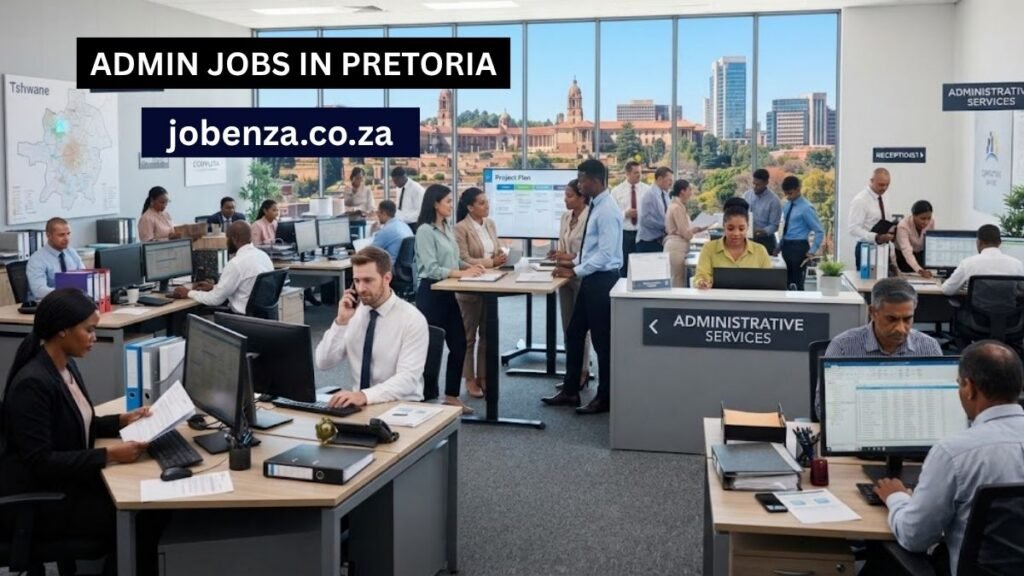
Pretoria is South Africa’s executive capital and the seat of the national executive. The Union Buildings sit in Arcadia, and the majority of national government departments keep their head offices within a 20-minute drive of Church Square.
That single fact shapes the entire job market. Government is a paperwork-intensive employer, and administrative staff are the delivery layer that keeps it functioning.
Why the capital creates constant administrative demand
The City of Tshwane is home to roughly 4 million residents and hosts an unusual concentration of institutions per capita. Departments, state-owned entities, research councils, embassies, academic campuses and academic hospitals all cluster here.
Each of those organisations needs registry clerks, secretaries, data capturers, supply chain clerks and personal assistants. Demand for admin jobs in pretoria is therefore structural rather than seasonal.
Private enterprise adds a second layer. The eastern corporate nodes, the industrial belt in the west and north, and the professional-services corridor along Lynnwood Road generate a steady flow of vacancies every single week.
Two hiring engines that work very differently
Public sector and private sector recruitment in Pretoria operate on completely separate logic. Understanding the difference is the single biggest advantage a job seeker can hold.
- Public sector: advertised through the weekly DPSA Public Service Vacancy Circular, applied for with a Z83 form, screened mechanically against stated minimums, and slow — often 3 months from closing date to outcome.
- Private sector: advertised through job portals and recruitment agencies, screened by keyword-matching software, and fast — sometimes 48 hours from application to first call.
Applying to both streams doubles your reach. Most candidates chasing admin jobs in pretoria work only one, which is precisely why they wait so long for a result.
Core Sectors and Opportunities for Office Admin Jobs in Pretoria

The best office admin jobs in pretoria are hidden in plain sight inside six major employer clusters. Each cluster hires for a different flavour of administration, and each rewards a slightly different skill set.
1. National government and state entities
This is the largest single employer group in the city. Departments are concentrated in the CBD, Arcadia, Hatfield and Sunnyside, while state entities and research councils sit in Brummeria, Erasmuskloof, Silverton and neighbouring Centurion.
Typical titles include Administration Clerk, Registry Clerk, Secretary, Data Capturer, Supply Chain Clerk, Human Resource Clerk and Finance Clerk. Entry usually requires nothing more than a Grade 12 certificate.
2. Legal, conveyancing and court services
Pretoria hosts the Gauteng Division of the High Court, one of the country’s busiest Deeds Registries, and the Master of the High Court. Around these institutions sits a thick ring of attorneys’ practices in the CBD, Brooklyn, Hatfield and Lynnwood.
Legal secretaries, conveyancing secretaries, litigation typists and file clerks are in permanent demand. Conveyancing experience in particular commands a premium because the skill takes years to build.
3. Healthcare and medical administration
Academic and district hospitals such as Steve Biko Academic, Kalafong, Tshwane District and Dr George Mukhari employ large patient-administration teams. Private hospital groups and the hundreds of specialist practices in Pretoria East add a parallel private market.
Roles include Patient Administration Clerk, Admissions Clerk, Medical Receptionist and Billing or Claims Clerk. Knowledge of ICD-10 coding and medical aid claim submission makes you instantly more employable here.
4. Universities, TVET colleges and research bodies
The University of Pretoria, UNISA’s Muckleneuk campus, Tshwane University of Technology and Sefako Makgatho Health Sciences University collectively administer hundreds of thousands of students.
Faculty administrators, student records officers, examination administrators and residence admin staff are recruited in visible waves around registration season in January and February. Applying two months ahead of that window is a genuine tactical edge.
5. Manufacturing, automotive and logistics
Rosslyn is a major automotive assembly hub, Silverton hosts large-scale vehicle manufacturing, and Waltloo, Hermanstad, Pretoria West and Babelegi carry the supporting industrial base.
These employers hire Stores Clerks, Receiving and Despatch Clerks, Procurement Administrators, Production Administrators, SHEQ Administrators and Wage Clerks. ERP exposure matters far more here than a polished telephone manner.
6. Retail, property and centre management
Menlyn Park, Woodlands Boulevard, Brooklyn Mall, Kolonnade and Wonderpark all run centre-management offices. Add property funds, managing agents and estate agencies, and you get steady demand for leasing administrators, debtors clerks and reception-plus-admin hybrids.
Competition for office admin jobs in pretoria is real, but it is spread across six very different arenas. Choose the arena that matches your existing skills instead of applying blindly to all of them.
On-the-Ground Responsibilities in Admin Clerk Jobs in Pretoria
Job adverts describe duties in generic language. The reality of admin clerk jobs in pretoria is far more specific, and understanding it lets you speak the employer’s language in your CV and interview.
The daily rhythm of the role
- Capturing data, invoices, leave forms, registers and statistics accurately and on deadline
- Opening, indexing, filing and retrieving records according to an approved file plan
- Handling walk-in enquiries, switchboard calls and email correspondence professionally
- Drafting routine correspondence, memoranda, submissions and minutes
- Supporting procurement through requisitions, quotations, order tracking and supplier follow-ups
- Processing petty cash, travel and subsistence claims, and reconciling supporting documents
- Maintaining attendance, asset and stationery registers
- Preparing meeting packs, booking venues and managing diaries for senior staff
Document control is the underrated core skill
In the public service, records must be filed according to an approved file plan under the National Archives framework. Getting this wrong creates audit findings, which is why registry experience is valued so highly.
Across every sector, POPIA compliance now governs how personal information is captured, stored, shared and destroyed. Candidates who can speak confidently about confidentiality, access control and secure disposal immediately sound more senior than their years.
Systems and software employers actually test
Software fluency separates the shortlisted from the ignored. Build competence in this order:
- Microsoft Outlook, Word and Excel — non-negotiable across every employer type
- Intermediate to advanced Excel — filters, pivot tables, VLOOKUP or XLOOKUP, conditional formatting
- Sage Pastel or Sage VIP — dominant in SMEs, practices and manufacturing
- SAP or Syspro — common in corporates, automotive plants and large state entities
- PERSAL, BAS and LOGIS — the government personnel, financial and procurement systems
That final point is the insider tip most candidates miss. Naming PERSAL, BAS or LOGIS on a public-sector CV signals that you already understand how a department runs.
What the money actually looks like
Public-sector pay is transparent and published. In 2026, an Administration Clerk post at salary Level 5 is commonly advertised at R237 453 to R279 708 per annum, which is roughly R19 800 per month at the entry notch before deductions.
Private-sector figures sit lower on average. Entry-level clerks typically earn around R6 000 to R8 500 per month, experienced clerks R8 500 to R13 000, and senior administrators or office managers R13 000 to R25 000 and above.
Government packages also carry a housing allowance, GEPF pension membership and subsidised medical aid. Always verify the current figure on the advert itself, because salary levels are adjusted annually.
Corporate Hotspots: Finding Admin Jobs in Pretoria East

If you are chasing the highest-paying corporate roles, admin jobs in pretoria east should sit at the top of your search list. The eastern suburbs concentrate financial services, consulting, engineering, medical specialists and professional practices into a handful of premium nodes.
Menlyn and Menlyn Maine
Menlyn Maine is a purpose-built green precinct of corporate towers, hotels and entertainment, sitting beside one of the country’s largest shopping centres. Financial services firms, consultancies and listed corporates keep offices here.
Expect roles such as Office Administrator, Executive Assistant, Client Services Administrator and Compliance Administrator. Standards are high, and so is the pay.
Lynnwood, Lynnwood Bridge and Hazelwood
The Lynnwood Road corridor is Pretoria’s engineering and professional-services spine. Mixed-use precincts here host consulting engineers, auditors, medical suites and boutique law firms.
Administrative roles in these offices frequently blend reception, bookkeeping support and project administration. Versatility is rewarded more than narrow specialisation.
Brooklyn, Waterkloof and Nieuw Muckleneuk
This is the diplomatic and institutional belt. Embassies, high commissions, revenue and regulatory offices and long-established attorneys’ practices all operate from these leafy suburbs.
Embassy and mission administration roles are rare but excellent, often requiring strong written English, discretion and impeccable record-keeping.
Faerie Glen, Garsfontein, Die Wilgers, Equestria and Silver Lakes
This is the SME and professional-practice belt — accountants, attorneys, brokers, medical practices, estate agencies and small consultancies. Vacancies here are numerous but advertised quietly, often through job portals rather than large agencies.
Smaller teams mean broader responsibility. You will invoice, file, order stock and manage clients in the same afternoon, which builds an unusually strong CV within two years.
Two practical realities of working in the east
First, most admin jobs in pretoria east are located in office parks and estates with limited public transport access. A valid Code B driver’s licence and reliable transport materially widen the number of jobs you can realistically accept.
Second, corporate employers in these nodes commonly pay above CBD equivalents for the same job title, because they compete with Centurion, Midrand and Sandton for the same talent pool. If you have solid experience, do not undersell yourself when the salary question arrives.
How to Stand Out and Get Hired
Employers filling admin jobs in pretoria receive hundreds of near-identical applications. Standing out is less about talent and more about removing every reason a screener could use to reject you.
Qualifications that unlock the shortlist
- Matric (NSC) or NCV Level 4 — the baseline requirement for almost every entry-level post
- Business Administration Services NQF Level 2, 3 or 4 — widely offered through learnerships
- N4 to N6 Management Assistant or Business Management at a Tshwane TVET college, converting to a National N Diploma after 18 months of workplace experience
- National Diploma in Office Management, Public Administration or Business Administration from UNISA or TUT
- Computer literacy certification covering the full Microsoft Office suite
- Short courses in Advanced Excel, bookkeeping, records management or minute-taking
- A valid driver’s licence, which appears as a requirement on a surprising share of adverts
Building a CV that survives South African screening
Keep it to 2 to 3 pages, save it as a PDF, and name the file properly — “Thandi Mokoena – Administration Clerk CV.pdf” beats “cv final final.pdf” every time.
Include the details South African employers expect: ID number, citizenship, suburb, driver’s licence code, notice period and whether you have your own transport. Omitting these creates friction that screeners will not chase you for.
List three contactable references with job titles, phone numbers and email addresses. Warn your referees in advance so they answer confidently.
Create a dedicated “Systems and Software” block near the top. Recruitment software matches keywords, so if the advert says Pastel, SAP or PERSAL and your CV never uses those words, you will not be found.
Quantify every duty you list. “Captured over 250 supplier invoices weekly with a 99% accuracy rate” outperforms “responsible for data capturing” in every screening scenario.
Finally, tailor the top third of your CV to each advert. Mirror the employer’s exact job title and mention the sector by name.
Applying for government posts without disqualifying yourself
Public-sector applications fail on technicalities far more often than on merit. Follow these rules precisely:
- Use the Z83 form effective 1 January 2021. Older versions lead to automatic disqualification.
- Complete Parts A to D in full. For Parts E to G you may write “refer to CV”, but the question on conditions preventing re-appointment must still be answered.
- Sign, date and initial the form as instructed. An unsigned Z83 is dead on arrival.
- Submit one Z83 per post, and quote the reference number exactly as it appears in the advert.
- Attach only a detailed CV. Certified copies are requested from shortlisted candidates, and must generally be no older than 6 months at that stage.
- Send your application to the advertising department, never to the DPSA itself.
- Check the circular weekly — it is published every Friday for most of the year.
If you have not been contacted within 3 months of the closing date, most adverts state that your application was unsuccessful. Keep applying rather than waiting.
Mastering the interview and assessments
Administrative interviews in Pretoria increasingly include a practical component. Prepare for a typing test, a timed Excel exercise, a filing or in-tray simulation, and — in the public service — an integrity assessment.
Answer competency questions using the STAR method: Situation, Task, Action, Result. Prepare three strong stories in advance covering a deadline under pressure, a difficult client or colleague, and a mistake you corrected.
Rehearse answers to the questions that come up almost every time: how you prioritise competing deadlines, how you handle confidential information, which systems you have used, and why you want this specific role.
Arrive with originals of your ID and qualifications, a printed CV, and a notebook. Ask at least one intelligent question about the team or the department’s priorities.
If you have no experience yet
Start with learnerships, government internships, the YES programme and free youth employment platforms. A 12 to 24 month internship inside a department is one of the fastest routes into permanent public-service employment.
Volunteering to run the registry at a school, clinic or NPO also counts as genuine experience. Employers hire evidence, not excuses.
Your Ultimate Career Partner: Explore Daily Verified Opportunities on Jobenza

Finding admin jobs in pretoria is a numbers game — but only if the numbers are current. Expired listings and recycled adverts waste the hours you should be spending on tailored applications.
That is exactly the problem jobenza.co.za was built to solve. Jobenza publishes fresh, verified vacancies across South Africa daily, organised so you can filter by province, city and sector instead of scrolling endlessly.
Here is how to use the platform properly:
- Browse the active listings for Gauteng and Pretoria first thing each morning, before the applicant volume climbs
- Set up real-time job alerts so new administrative vacancies reach you the day they are published
- Filter by suburb and sector to separate CBD government posts from corporate admin jobs in pretoria east
- Apply directly through the listing while the advert is still open
- Bookmark jobenza.co.za and make it a daily habit, because early applicants are read first
Explore the full range of administrative, clerical and office-support opportunities on Jobenza today. One genuine, well-matched application beats fifty rushed ones.
A final safety note: no legitimate employer or platform will ever ask you to pay for a job, an interview or a “placement fee”. Walk away from anyone who does.
Conclusion: Your Administrative Career Starts Here
Pretoria rewards administrative professionals who understand the market they are entering. The capital offers something few South African cities can match — genuine volume, real variety and a public sector that hires consistently from Grade 12 upward.
Choose your arena, learn the systems that arena tests for, and write a CV that mirrors the advert in front of you. Then apply early, apply often, and apply properly.
Whether you are targeting entry-level admin clerk jobs in pretoria or a senior corporate role in Menlyn, the path is the same: preparation, precision and persistence. Start browsing verified listings on Jobenza today, and turn your next application into an interview.
Frequently Asked Questions
Do I need Matric to apply for admin jobs in pretoria? For almost all formal roles, yes. Grade 12, an NCV Level 4 or an equivalent NQF Level 4 qualification is the standard minimum, and government posts state it explicitly.
How much do admin clerk jobs in Pretoria pay? Private-sector clerks typically earn R6 000 to R13 000 per month depending on experience. Public-service Level 5 posts were commonly advertised at R237 453 per annum in 2026, roughly R19 800 monthly before deductions, plus benefits.
Do I really need a driver’s licence? Not for every job, but it widens your options considerably. Many corporate offices and industrial sites are poorly served by public transport, and a Code B licence appears as a requirement on a large share of adverts.
How long does a government application take? Expect a slow process. Shortlisting alone can take weeks, and most adverts state that no response within 3 months of the closing date means the application was unsuccessful.
Are admin jobs in Pretoria East better paid than CBD roles? Corporate employers in nodes like Menlyn and Lynnwood generally pay above small-business CBD rates for the same title. Government posts, however, follow national salary levels regardless of suburb.
Can I get hired with no experience? Yes. Learnerships, internships and entry-level clerk posts explicitly advertised as requiring no prior experience are your entry points. Pair them with a computer literacy certificate to stand out.
Which software should I learn first? Master Excel beyond the basics, then add Sage Pastel. If you are targeting government, familiarity with PERSAL, BAS or LOGIS is a powerful differentiator.
Are there remote or hybrid admin roles in Pretoria? A limited number exist, mostly in client services, virtual assistance and data capturing. Most administrative work in Tshwane remains office-based, because registry, reception and document control require physical presence.