


Security jobs have quietly become one of the largest sources of formal employment in South Africa, and the hiring taps are still wide open. From the boom gate of a Sandton office park to the alert queue of a 24/7 security operations centre, protection work now touches almost every industry in the country.
The scale is remarkable. PSIRA’s recent annual reporting puts registered security personnel near 2.9 million, with roughly 640,000 actively employed across more than 22,000 registered businesses — a workforce that outnumbers the South African Police Service roughly three to one.
Behind those numbers sits an industry worth around R50 billion a year, employing everyone from first-time matriculants to specialists defending bank networks from ransomware.
This guide covers security jobs from every angle. You will find PSIRA registration rules, grade-by-grade career paths, the real hiring hotspots in Durban, Cape Town and Pretoria, the rise of digital defence roles, and a practical playbook for CVs and interviews.
The State of the Private Security Industry in South Africa

South Africa’s private security sector grew because demand never let up. Persistent property crime, cash-in-transit heists, cable and infrastructure theft, retail shrinkage and a stretched police service pushed households, retailers, mines and municipalities toward private protection.
Growth has also shifted shape. Guarding remains the backbone, but security jobs today increasingly demand officers who can handle CCTV analytics, biometric access control, licence plate recognition, drone monitoring and digital incident reporting.
That shift matters for your earning potential: officers who pair a solid grade with technical confidence move up fastest.
PSIRA: The Gatekeeper You Cannot Skip
The Private Security Industry Regulatory Authority regulates the entire sector under the Private Security Industry Regulation Act 56 of 2001. It reports to the Minister of Police and registers every security officer, security business and training provider in the country.
Taking security jobs without valid registration is a criminal offence, not an administrative slip. Employers verify your PSIRA number and status before you set foot on site, and clients frequently re-verify officers deployed on their contracts.
To register as an individual, you generally must:
- Be 18 years or older
- Be a South African citizen or permanent resident (foreign nationals need a valid permit authorising security work, verified against Home Affairs records)
- Complete training at a PSIRA-accredited training centre
- Submit fingerprints for a criminal record check and be clear of the scheduled offences listed in the Act
- Not be a serving member of any military, police or intelligence service, in South Africa or elsewhere
- Pay the prescribed registration fee and keep your registration current
Two 2026 changes matter before you enrol anywhere. PSIRA now requires new entrants to pre-register before starting security officer training, and it has introduced competency certificates as formal proof that prescribed training was achieved. Confirm both on psira.co.za before paying any training provider.
PSIRA Grades E to A Explained
Your grade determines which security jobs you may legally be deployed to and sets the ceiling on your pay. You start at Grade E and work upward, completing accredited training at each level.
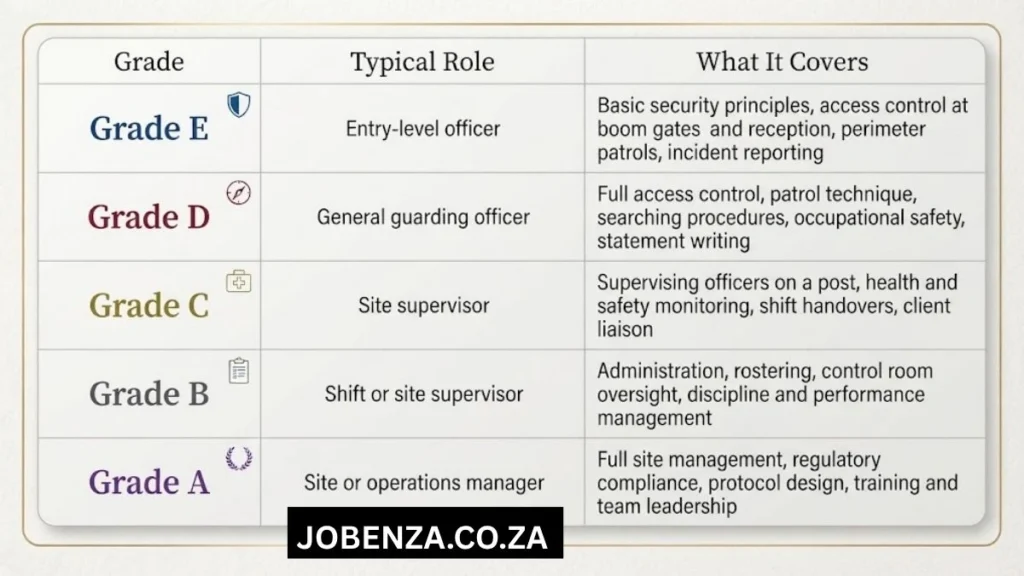
Beyond the core grades, specialised courses unlock the higher-paying posts. These include reaction or armed response officer training, firearm competency under the Firearms Control Act 60 of 2000, cash-in-transit, close protection, control room and off-site monitoring, event and crowd control, and first aid.
Wages in the sector are set by grade and by geographic area under the sector’s collective agreement, sitting above the National Minimum Wage baseline. Because those schedules are renegotiated regularly, always check the current rates before accepting an offer, and treat any employer paying below them as a serious red flag.
Regional Hotspots: Where the Hiring Actually Happens
Security jobs are advertised nationwide and volumes are strongest in Gauteng, yet each metro has its own hiring personality. Understanding that personality helps you target applications instead of spraying CVs everywhere.
Security Jobs in Durban: Ports, Freight and Industrial Risk
Security jobs in Durban are shaped by one dominant feature: the busiest container port in sub-Saharan Africa. Cargo moves constantly through the harbour precinct, and every stage of that movement needs protection.
Port-adjacent employers hire for warehouse and yard security, container seal verification, gatehouse access control, truck marshalling and cargo escort duty. The N3 corridor toward Gauteng adds a steady flow of freight and logistics postings around Pinetown, Cato Ridge, Prospecton and Mobeni.
Heavy industry compounds demand. The chemical, sugar and manufacturing belt south of the city wants officers comfortable with hazardous environments, safety inductions and strict access registers.
The coastal growth corridor adds more. Umhlanga, Ballito and La Lucia have expanded into corporate and estate territory, generating steady openings in estate access control, armed response and off-site monitoring.
When scanning security jobs in Durban, prioritise these advantages on your CV:
- Familiarity with port, warehouse or logistics environments
- isiZulu fluency alongside English, which is heavily favoured by KZN employers
- A valid driver’s licence for patrol vehicle and escort work
- Any experience with unrest or civil disruption risk protocols, which KZN employers take seriously
Security Jobs Cape Town: Tourism, Corporate and Estate Protection
The Western Cape market runs on a different clock. Searches for security jobs Cape Town climb sharply ahead of the summer season, because hotels, guesthouses, restaurants and attractions staff up from roughly October through April.
Tourism security is a genuine specialisation here. The V&A Waterfront, Atlantic Seaboard hotels, Table Mountain access points and the city’s festival calendar all need officers who are visibly professional, calm with international visitors and confident in crowd flow management.
Event security is the natural companion. Major races, festivals and stadium events create short-notice contracts that reward officers with crowd control and first aid credentials.
Corporate demand is equally strong. Century City, the Foreshore and the Woodstock and Salt River tech belt host head offices, BPO operations and data-sensitive businesses that need access control, visitor management and control room staffing.
Residential estate security rounds out the picture. Estates across the Southern Suburbs, the Winelands and Paarl recruit for access control, patrol and armed reaction, and they often expect biometric and licence plate recognition system familiarity.
Applicants chasing security jobs Cape Town should highlight customer-facing polish, Afrikaans or isiXhosa alongside English, and any hospitality or retail loss control history.
Security Jobs in Pretoria: Diplomatic, Government and High-Vetting Work
Tshwane is the country’s administrative capital, and that single fact defines the market. Security jobs in Pretoria cluster around government departments, national key points, state-owned entities and the diplomatic quarter running through Arcadia, Hatfield, Brooklyn and Waterkloof.
Embassy and high commission contracts are the prestige tier. They typically demand a higher grade, an unblemished record, formal vetting, excellent English written reporting and absolute discretion.
Government and parastatal sites add volume: departmental head offices, research institutions, defence-linked entities, courts and campuses including UP, TUT and UNISA. These posts reward officers who document accurately and follow protocol without improvisation.
Corporate demand concentrates in Centurion, Menlyn and the Lynnwood corridor, where office parks and retail centres hire for control room operation, loss control and asset protection.
Close protection is also unusually active here, given the concentration of officials, executives and visiting delegations. Candidates for security jobs in Pretoria should invest early in higher grades, vetting readiness and clean documentation, because paperwork failures cost more contracts in this region than anywhere else.
The Rise of Digital Defence: Cyber Security Jobs in South Africa

While guarding protects physical assets, cyber security jobs protect the systems those assets increasingly run on. Banks, insurers, telcos, retailers, hospitals, municipalities and mining groups have all been hit by ransomware, phishing and data breaches, and boards have finally started funding defence properly.
Two laws drive much of the hiring in cyber security jobs. The Protection of Personal Information Act (POPIA) makes organisations accountable for personal data, and the Cybercrimes Act 19 of 2020 formalises offences and reporting duties. Compliance obligations create permanent roles, not once-off projects.
The Roles Employers Are Advertising
- SOC analyst (L1 to L3) — monitoring alerts, triaging incidents, escalating confirmed threats, often on 24/7 shift rotations
- Incident response and digital forensics analyst — containing live attacks and reconstructing what happened
- GRC and compliance specialist — POPIA readiness, risk registers, audit evidence, policy management
- Penetration tester and red teamer — simulating attacks to expose weaknesses before criminals find them
- Cloud and identity security engineer — securing Microsoft 365, Azure and AWS estates, plus access management
- Security architect and CISO — designing defence strategy and owning it at executive level
Pay and Progression
Reported figures vary widely between sources, so treat published ranges as indicative rather than exact. Broadly, entry-level analyst roles are commonly advertised in the region of R18,000 to R30,000 per month, mid-level analysts around R35,000 to R55,000, and senior engineers, architects and leads from R55,000 to R90,000 and upward.
In cyber security jobs, certifications move your number faster than tenure does. CompTIA Security+ and Network+ open the door, CySA+, CEH and Microsoft SC-200 build credibility, and CISSP, CISM and cloud security specialisations anchor senior pay.
Breaking In Without a Degree
A degree helps, but it is not the only route. Many South African analysts arrive via IT helpdesk or network support, then add certifications, a home lab and capture-the-flag practice.
MICT SETA learnerships, NQF-aligned qualifications and vendor bootcamps offer structured entry points. Guarding experience is not wasted either: control room operators who understand alarm signalling, CCTV analytics and incident escalation already think the way SOC work demands.
How to Land a Security Job: Your Step-by-Step Plan
- Verify the training provider first. Confirm accreditation on the PSIRA website and complete the new pre-registration step before you pay for any course.
- Complete Grade E and D. These two grades qualify you for the majority of entry-level security jobs in guarding.
- Register with PSIRA. Submit fingerprints, supporting documents and the prescribed fee, then track your status online until it shows as active.
- Prepare your background. Criminal record checks are non-negotiable, and honesty about your history is always better than discovery mid-process.
- Meet the physical standard. Long shifts, night work and foot patrols require stamina; some employers run fitness and medical assessments.
- Add a licence and specialisations. A driver’s licence unlocks armed response and escort roles, while firearm competency, first aid and control room courses raise your rate.
- Climb to Grade C and above. Supervisory grades are where meaningful pay increases begin.
- Protect yourself from scams. Legitimate employers do not charge you for a job. Verify any company’s registration status on psira.co.za before handing over documents or money.
Writing a Standout Security CV and Acing the Interview
Recruiters filling security jobs screen for compliance before personality. Your CV should therefore answer their compliance questions in the first ten seconds.
CV Essentials
- Lead with your credentials. Put your PSIRA number, current grade and certificate expiry date in the header, not buried on page two.
- List every completed grade and special course with the accredited provider’s name and completion dates.
- State your firearm competency status clearly, including the category, if you hold one.
- Describe sites, not just duties. “Access control for a 400-unit residential estate with biometric readers and ANPR” beats “guarded premises.”
- Quantify results where you can: incident reports filed, shrinkage reduced, audits passed, shifts without incident.
- Name your systems. CCTV and VMS platforms, alarm signalling software, access control systems and digital patrol or reporting apps.
- List your languages. Multilingual officers are consistently favoured, especially in KZN, the Western Cape and Gauteng.
- Confirm logistics. Driver’s licence code, shift availability, willingness to relocate and contactable references.
- Keep it to two pages, save it as a PDF, and name the file professionally: Surname_Name_SecurityCV.pdf.
Interview Checklist
- Bring originals plus certified copies of your ID, PSIRA certificate, grade certificates and driver’s licence.
- Arrive at least 20 minutes early, groomed to uniform standard. Punctuality is being assessed from the moment you arrive.
- Research the employer’s contracts so you can speak to the environment: retail, industrial, estate, hospital, mining or corporate.
- Prepare two or three real incident stories using a simple structure: situation, action you took, outcome, what you documented.
- Know the boundaries of your authority, including reasonable use of force, search procedures and when to escalate to SAPS.
- Expect vetting. Background checks, reference calls and, in retail and cash-handling roles, integrity screening are standard practice.
- Ask informed questions about shift patterns, overtime, transport arrangements and progression to the next grade.
- Close by confirming your availability to start and your registration status, which the employer can verify instantly.
Find Your Next Security Role Instantly on Jobenza
Hunting for security jobs across a dozen sites, chasing dead listings and re-entering the same details is the fastest way to lose momentum. jobenza.co.za exists to remove that friction for South African job seekers.
Jobenza brings live security jobs into one place so you can spend your energy on applications instead of searching. Whether you want entry-level guarding, supervisory posts, armed response, control room work or high-paying cyber security jobs, the listings are organised for fast filtering.
Here is how to get the most out of the platform:
- Filter by your city and province to surface security jobs in Durban, security jobs Cape Town and security jobs in Pretoria without wading through irrelevant national results.
- Set up job alerts so new roles matching your grade and location reach you while the vacancy is still fresh. Early applicants are shortlisted more often.
- Save your searches for guarding, armed reaction, retail loss control and cyber roles, then check them daily as new listings are published.
- Apply directly through the listing while your documents are ready to attach.
- Bookmark jobenza.co.za and make it your first stop each morning. Consistency beats intensity in any serious job hunt.
Explore related categories too. Many security professionals move sideways into logistics, facilities management, retail operations or IT support, and those adjacent listings sit on the same platform.
Conclusion: A Career With Real Ladders
South Africa’s security industry offers something increasingly rare: an entry point that needs no degree, attached to a ladder that keeps going. A Grade E certificate can lead to supervisory management, close protection, control room specialisation or a well-paid seat in a security operations centre.
The candidates who win the best security jobs are simply the most deliberate. They keep their PSIRA registration current, add one specialisation each year, document their site experience properly and apply early to fresh listings.
Start where you are, get compliant, and keep building. Then let jobenza.co.za handle the searching while you focus on landing the role.
Frequently Asked Questions
What qualifications do I need to start working in security? For most entry-level security jobs, you need PSIRA Grades E and D completed at an accredited training centre, valid PSIRA registration and a clean criminal record. Matric is not always mandatory, but it strengthens applications and is often required for supervisory and control room roles.
How long does PSIRA registration take? Grade E training itself is short, often around a week, while registration timelines depend on document completeness and the criminal record check. Applications commonly take several weeks, and missing certificates or poor-quality fingerprints are the most frequent causes of delays.
Can foreign nationals work in South African security? Only with permanent residence or a valid permit authorising work in the security industry, verified against Home Affairs records. Employers cannot legally deploy unregistered officers, so confirm your eligibility before enrolling for training.
How much do security officers earn? Pay depends on your grade, your area and the sector’s collective wage schedule. Entry-level guarding starts modestly and rises sharply at supervisory grades and in armed, cash-in-transit and close protection roles. Always verify the current schedule and reject offers below it.
Do I need a firearm competency certificate? Only for armed posts. Armed response, cash-in-transit and close protection roles require competency under the Firearms Control Act 60 of 2000, obtained through accredited training, and it is one of the highest-return credentials in the guarding sector.
Can I get into cyber security jobs without a degree? Yes. Many South African professionals enter cyber security jobs through IT support, certifications such as CompTIA Security+, learnerships and demonstrable home lab or capture-the-flag experience. Employers care about proof of skill, and a portfolio of practical work is powerful evidence.
Which city has the most security jobs? Gauteng carries the highest overall volume, but each metro has distinct strengths: security jobs in Durban revolve around the port and logistics, security jobs Cape Town are driven by tourism, corporate and estate demand, and security jobs in Pretoria centre on government, diplomatic and high-vetting environments.
How do I avoid job scams in the security industry? Never pay a fee to be placed in a job, and be sceptical of “uniform deposits” or upfront charges. Verify the company’s registration on the PSIRA website, insist on a written contract, and apply through established platforms such as jobenza.co.za rather than unverified social media posts.