

Cape Town’s education sector is experiencing a quiet but significant transformation. Between growing enrolment in independent schools, an expanding international school footprint, and ongoing recruitment drives within the public system, there has never been a more dynamic time to explore teaching jobs in Cape Town. Whether you are a newly qualified graduate, an experienced Foundation Phase specialist, or an international educator eyeing a move to the Mother City, the opportunities are broader than most job seekers realise.
At the same time, the process of finding and securing teaching jobs in Cape Town can feel overwhelming. Between navigating SACE registration, understanding the difference between a B.Ed and a PGCE, decoding the Western Cape Education Department jobs application system, and preparing for a demonstration lesson in front of a governing body, there are many moving parts that determine whether you land the role you want.
This guide breaks down everything you need to know: how the market is structured, what qualifications and legal requirements you must meet, where to search for educator vacancies Cape Town wide, how to build an application that gets shortlisted, and what to expect once you’re called in for an interview. Whether your goal is a permanent post in a public school, a role in a well-resourced private institution, or international school teaching Cape Town positions that pay in a globally competitive currency, this article will help you move forward with clarity and confidence.
Overview of the Teaching Job Market in Cape Town

Cape Town’s schooling landscape is generally divided into three broad categories, each with distinct hiring processes, salary structures, and expectations. Understanding these differences is the first step to strategically pursuing teaching jobs in Cape Town.
Public Schools
Public schools fall under the Western Cape Education Department jobs system and represent the largest employer of teachers in the province. These posts are governed by the Department of Basic Education’s national policies, with salaries determined by the Public Service Coordinating Bargaining Council salary scales. Public school posts tend to offer strong job security, structured career progression (from Level 1 educator through to Head of Department, Deputy Principal, and Principal), and access to a government pension fund and medical aid subsidy.
Private and Independent Schools
Independent schools operate outside of direct state control but are still regulated for curriculum and educator standards. Many belong to the Independent Schools Association of Southern Africa, and hiring is generally faster and more decentralised, with each school’s governing body driving recruitment. Salaries in this sector vary considerably: well-established, fee-paying independent schools often pay above the public sector scale, while smaller or newer schools may offer less but provide other non-monetary benefits like smaller class sizes or unique teaching philosophies (Montessori, Waldorf, or STEM-focused academies).
International Schools
International school teaching Cape Town roles are highly sought after, particularly by educators offering an IB (International Baccalaureate), Cambridge (CAIE), or American curriculum background. These schools typically serve expatriate families and affluent local families, and they often benchmark salaries against international standards, sometimes offering relocation assistance, housing allowances, or tuition discounts for staff children. Competition for these positions is fierce, and schools usually prioritise candidates with several years of experience delivering an international curriculum.
High-Demand Subjects and Phases
Across all three sectors, certain subject specialisations remain consistently in demand:
- Mathematics and Physical Sciences — a national shortage means qualified STEM educators are highly employable.
- Information Technology and Computer Applications Technology (CAT) — driven by digital curriculum expansion.
- FET Phase (Grades 10–12) subject specialists, particularly in Accounting, Mathematics, and Life Sciences.
- Foundation Phase teachers with strong literacy and numeracy backgrounds, especially in the public sector where class sizes remain a challenge.
- English as an Additional Language (EAL) specialists, particularly valuable in international schools serving expatriate learners.
Salary and Benefits Expectations
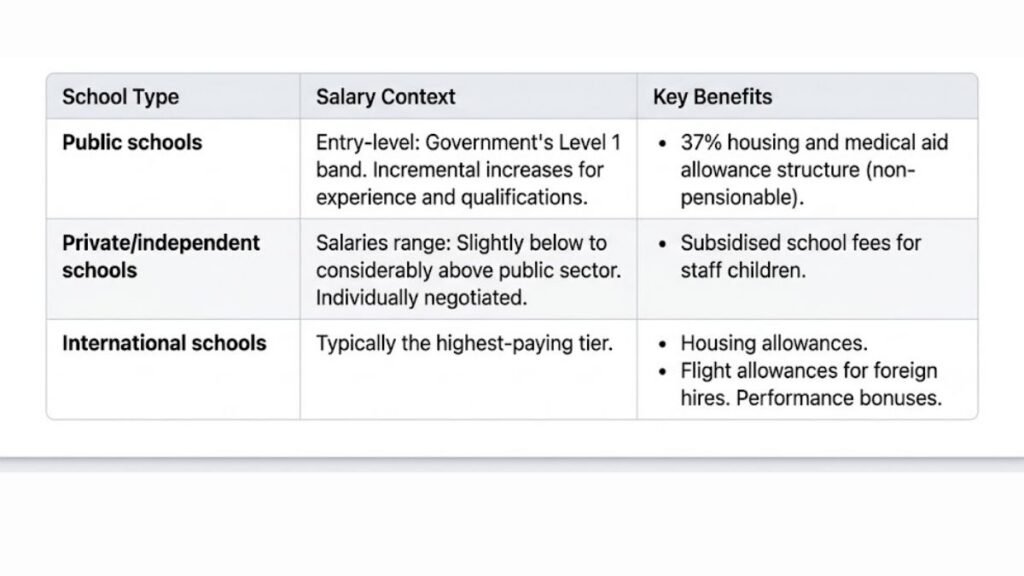
While exact figures vary by institution and experience level, general benchmarks for teaching jobs in Cape Town look roughly like this:
- Public schools: Entry-level educators typically start within the government’s Level 1 salary band, with incremental increases tied to experience and qualifications, plus a 37% (non-pensionable) housing and medical aid allowance structure.
- Private/independent schools: Salaries can range from slightly below to considerably above public sector scales, often negotiated individually, with benefits like subsidised school fees for staff children.
- International schools: Typically the highest-paying tier, sometimes including housing allowances, flight allowances for foreign hires, and performance bonuses.
Qualifications and Legal Requirements
Before applying for any post, it’s essential to understand the non-negotiable legal and academic requirements for teaching in South Africa. This is one of the areas where applicants most often get disqualified — not due to lack of skill, but due to incomplete paperwork.
Teaching Qualifications South Africa Requires
To legally teach in South Africa, your teaching qualifications South Africa recognizes must align with the Higher Education Qualifications Sub-Framework. The two most common routes are:
- Bachelor of Education (B.Ed) — A four-year undergraduate degree combining subject content knowledge with pedagogical training. This is the most direct route into the profession and is highly regarded by both public and private employers.
- Postgraduate Certificate in Education (PGCE) — A one-year (or part-time equivalent) qualification for candidates who already hold a Bachelor’s degree in another field (e.g., BSc, BA, BCom) and wish to convert into teaching. This route is popular among career-changers and is widely accepted across all school types.
Both qualifications must be obtained from a recognised, accredited South African institution, or — for foreign-trained teachers — evaluated and matched by the South African Qualifications Authority (SAQA) before they will be recognised locally.
SACE Registration
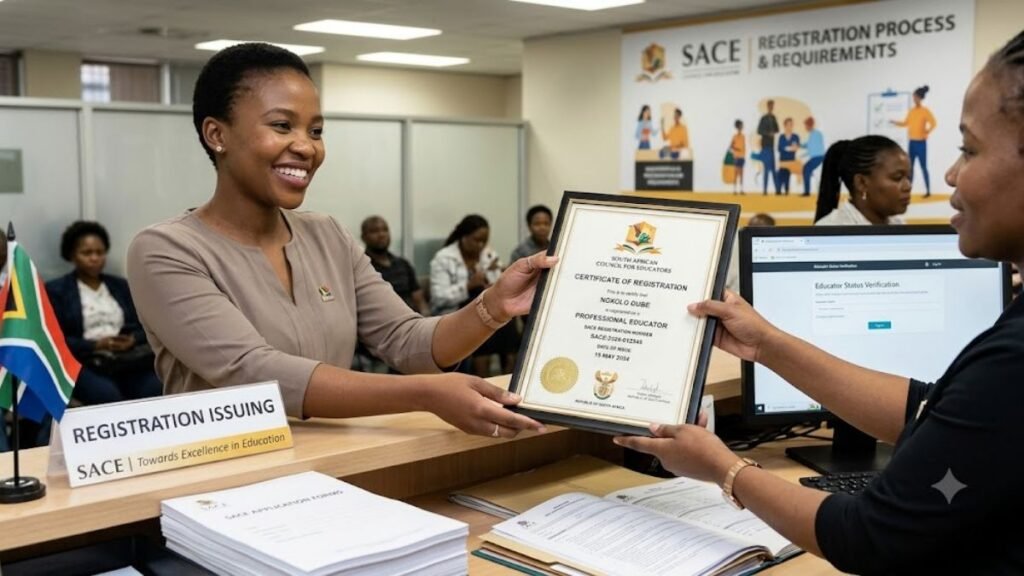
SACE registration is a legal prerequisite for anyone wishing to teach in South Africa, whether in a public, private, or international school. The South African Council for Educators is the professional body responsible for registering, regulating, and maintaining ethical standards among teachers.
Key points about SACE registration:
- It is mandatory before you can be permanently appointed to any teaching post.
- Newly qualified teachers typically apply for provisional registration while awaiting verification of their qualifications, then convert to full registration.
- SACE also handles a Code of Professional Ethics that all registered educators are bound by, and can investigate misconduct complaints.
- Renewal and continuing professional development points may be required to maintain good standing over time.
Applicants should apply for SACE registration as early as possible in their job search, since schools are legally restricted from permanently appointing unregistered candidates, and delays in receiving your certificate can cost you an offer.
Police Clearance and Child Protection Checks
Given that the role involves direct contact with minors, every prospective educator must undergo a police clearance check through the South African Police Service (SAPS), and increasingly, verification against the National Child Protection Register. Schools will not finalise an appointment without this clearance, so it’s wise to apply for your clearance certificate well ahead of active job hunting, as processing times can take several weeks.
Work Permits for Foreign and Expat Teachers
For non-South African citizens pursuing international school teaching Cape Town roles or other posts, a valid work visa is essential. This typically requires:
- A confirmed job offer from a registered South African employer.
- Proof of qualifications evaluated by SAQA.
- SACE registration or proof of eligibility.
- Department of Home Affairs approval of a General Work Visa or Critical Skills Work Visa (teaching and certain scarce-skill subjects like Mathematics and Science have historically appeared on critical skills lists).
Because visa processing can take months, international candidates should start this process as early as possible and work closely with their prospective school’s HR department, who often have experience guiding foreign hires through the process.
Where and How to Find Teaching Jobs in Cape Town
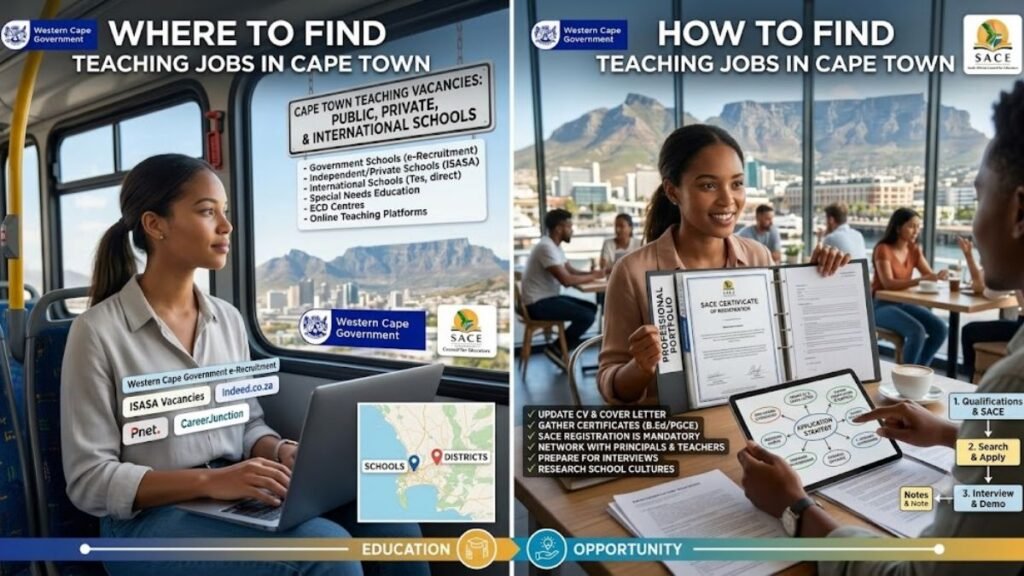
Once your qualifications, SACE registration, and clearances are in order, the next challenge is knowing where to look. Successful candidates typically use multiple channels simultaneously rather than relying on just one.
1. WCED e-Recruitment System
For anyone targeting Western Cape Education Department jobs, the provincial e-Recruitment portal is the official gateway to public school vacancies. Public school posts are advertised via periodic bulletins, and applicants must submit through the online system, ensuring all required documentation (certified qualifications, ID, SACE proof, CV, and references) is uploaded correctly and before the stipulated closing date. Because public sector hiring follows strict governance and equity procedures, punctuality and completeness of your application are critical — incomplete submissions are typically disqualified outright, regardless of merit.
2. Independent Schools Associations (ISASA)
The Independent Schools Association of Southern Africa is a valuable resource for candidates targeting private and independent institutions. ISASA-affiliated schools often list vacancies directly on the association’s site or refer candidates to individual school career pages. Since independent schools set their own hiring timelines (often outside of the traditional academic-year cycle followed by public schools), it’s worth checking these channels year-round rather than only at the start of a term.
3. Direct Outreach to Schools
Particularly for international school teaching Cape Town roles and boutique independent schools, direct outreach remains effective. Many schools do not always advertise widely and instead rely on speculative applications, referrals, or relationships with recruitment specialists. Building a shortlist of target schools, researching their ethos and curriculum, and sending a tailored CV and cover letter directly to the HR department or Principal can open doors that public job boards never advertise.
4. Dedicated Job Portals Like Jobenza.co.za
For a consolidated view of educator vacancies Cape Town wide — spanning public, private, and international postings — dedicated recruitment platforms like jobenza.co.za offer significant advantages over checking dozens of individual school websites. Using a platform like this allows you to:
- Browse actively updated listings across all school sectors in one place.
- Filter by subject specialisation, phase, location, and school type.
- Set up automated job alerts so new teaching jobs in Cape Town postings reach your inbox as soon as they go live — critical in a market where strong candidates are often shortlisted within days.
- Upload a CV once and apply to multiple relevant roles without repeating data entry for every application.
Combining WCED’s official system, ISASA listings, direct outreach, and a job portal like Jobenza gives you the broadest possible visibility into the market, rather than relying on chance encounters with vacancy notices.
Crafting a Winning Resume and Cover Letter for Teachers
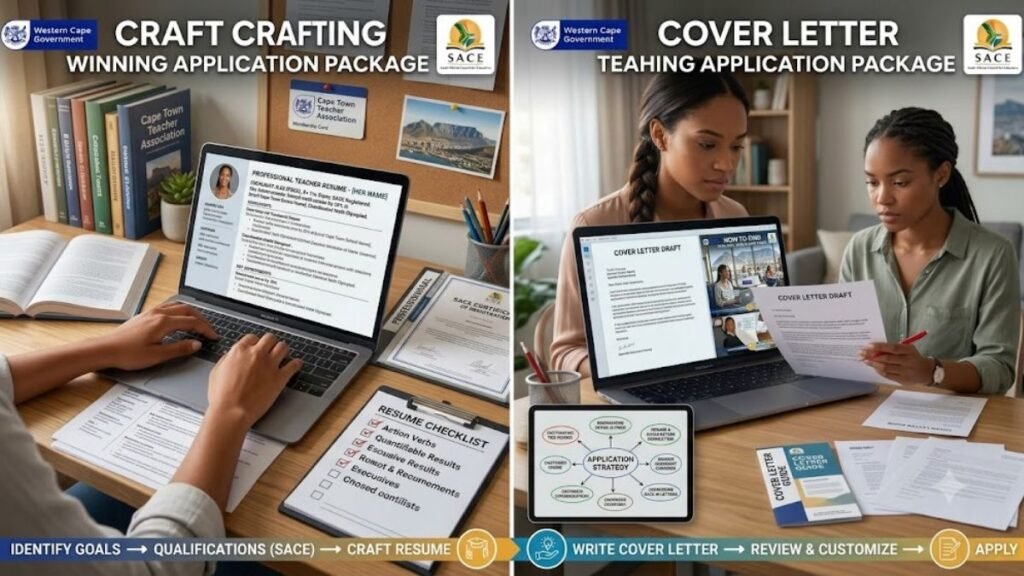
South African school hiring panels — whether public or private — read dozens, sometimes hundreds, of CVs per post. Standing out requires more than listing your qualifications; it requires demonstrating impact and fit.
Resume Tips
- Lead with your SACE number and qualification status. Recruiters scan for this immediately; burying it on page two wastes valuable attention.
- Quantify your impact wherever possible — for example, improvement in pass rates, extracurricular programmes you introduced, or academic results you contributed to.
- List phases and subjects clearly. Ambiguity about whether you teach Foundation Phase, Intermediate Phase, Senior Phase, or FET wastes a recruiter’s time and risks your CV being overlooked.
- Highlight curriculum experience explicitly if applying for international school teaching Cape Town posts — mention IB, Cambridge, or American curriculum exposure by name.
- Keep formatting clean and consistent. Avoid overly designed templates; South African school administrators generally prefer clear, easy-to-scan documents over graphic-heavy resumes.
- Include references from previous Principals or HODs, as reference checks in education are typically thorough and conducted early in the shortlisting process.
Cover Letter Tips
- Address the letter to the correct individual (Principal, HR Manager, or SGB chairperson) wherever the name is available — generic salutations signal a lack of research.
- Reference the specific school’s ethos, values, or recent achievements to demonstrate genuine interest rather than a mass-sent application.
- Briefly explain your teaching philosophy in a way that aligns with the school’s stated culture (e.g., inclusive education, academic rigour, or holistic development).
- Close with a clear, confident call to action — indicating your availability for an interview or demonstration lesson.
The Interview and Demonstration Lesson Process
Once shortlisted, candidates for teaching jobs in Cape Town should expect a multi-stage evaluation process, particularly for permanent public and reputable private posts.
What Interview Panels Typically Assess
School Governing Bodies (SGBs) and interview panels — often comprising the Principal, a Deputy Principal, an HOD, and an SGB representative — typically evaluate candidates on:
- Subject knowledge depth — probing questions about curriculum content, common learner misconceptions, and how you’d address them.
- Classroom management philosophy — how you handle discipline, differentiated learning needs, and inclusive education practices.
- Alignment with school values — particularly important in faith-based or values-driven independent schools.
- Communication and interpersonal skills — since teachers must engage confidently with learners, parents, and colleagues alike.
- Evidence of professional growth — ongoing courses, workshops, or SACE-endorsed professional development you’ve pursued.
The Demonstration Lesson
Many schools require a demonstration lesson — sometimes called a “mock lesson” — as part of the final selection stage. This is your opportunity to show, rather than just describe, your teaching ability. Panels are typically watching for:
- Lesson structure and pacing — a clear introduction, development, and consolidation phase within the allotted time.
- Learner engagement techniques — questioning strategies, use of resources, and how you manage varying ability levels within the same lesson.
- Command of the classroom — confidence, voice projection, and the ability to manage behaviour naturally without being overly authoritarian.
- Adaptability — how you respond when something doesn’t go according to plan, such as a technology failure or an unexpected learner question.
- Curriculum alignment — ensuring your lesson content and outcomes map clearly to the relevant CAPS, IB, or Cambridge curriculum requirements, depending on the school.
Preparation is key: request the topic and grade in advance if possible, prepare backup activities in case of time overruns, and rehearse your opening few minutes, since first impressions with a new group of learners set the tone for the entire lesson.
Conclusion & Call to Action
Cape Town’s education sector offers a genuinely diverse range of opportunities, from the structured stability of the public system to the global mobility offered by international schools. Succeeding in this market means understanding the distinct requirements of each sector, securing your SACE registration and clearances early, tailoring your CV and cover letter to reflect genuine fit, and preparing thoroughly for both interviews and demonstration lessons.
Whether you’re searching through the Western Cape Education Department jobs portal, connecting with ISASA-affiliated independent schools, or pursuing international school teaching Cape Town positions, the most successful candidates are those who stay organised, proactive, and visible across multiple channels simultaneously.
If you’re ready to take the next step in your teaching career, visit jobenza.co.za to explore the latest educator vacancies Cape Town has to offer. Upload your CV, set up personalised job alerts, and put yourself in front of schools actively hiring right now. Your next classroom — and your next career milestone — could be just one application away.